In a landmark development for India's space ambitions, the Indian Space Research Organisation (ISRO) has recorded another key achievement in the Gaganyaan mission. On April 10, 2026, the agency successfully completed the second Integrated Air Drop Test (IADT-02) at Sriharikota, validating critical parachute-based recovery systems for the Crew Module. This Gaganyaan mission success comes at a pivotal moment, as preparations for the first uncrewed orbital flight (G1) accelerate steadily. With over 8,000 ground tests already accomplished at a remarkable success rate, ISRO is methodically addressing every technical challenge to ensure crew safety before the historic crewed mission targeted for 2027.
The Gaganyaan mission represents more than a technical feat; it embodies India's aspiration to join the elite group of nations capable of independent human spaceflight. As the country marks steady progress in 2026—often referred to in official circles as one of the dedicated "Gaganyaan years"—this article delves deep into the latest successes, underlying technologies, astronaut preparations, and the broader implications. Whether you are tracking the Gaganyaan mission for academic purposes, UPSC preparation, or pure curiosity about ISRO's Gaganyaan mission, the details below offer a comprehensive, up-to-date overview grounded in the most recent developments.
Understanding the Gaganyaan Mission: India's Bold Leap into Human Spaceflight
The Gaganyaan mission is ISRO's flagship human spaceflight programme, designed to send Indian astronauts—known as Gaganyatris—into low Earth orbit aboard an indigenously developed spacecraft. At its core, the Gaganyaan mission aims to demonstrate end-to-end capabilities: safe launch, orbital operations, re-entry through Earth's atmosphere, and ocean recovery of the Crew Module. The spacecraft, weighing approximately 5.3 tonnes, will orbit at around 400 km altitude for up to seven days during the eventual crewed flight.
What sets the Gaganyaan mission apart is its emphasis on autonomy and safety. Unlike earlier robotic missions, every system here must meet stringent human-rating standards. The programme encompasses the Crew Module (CM) for habitable conditions, the Service Module (SM) for propulsion and power, and the human-rated Launch Vehicle Mark-3 (HLVM3), an upgraded version of the reliable LVM3 rocket. ISRO has integrated advanced life-support systems, environmental control, and an emergency Crew Escape System (CES) that can pull the Crew Module away from the rocket in milliseconds during any anomaly.
The Gaganyaan mission's objectives extend beyond the flight itself. It includes rigorous qualification of all hardware through ground simulations, drop tests, and abort demonstrations. Success in these areas not only paves the way for Indian astronauts in space but also fosters spin-off technologies in materials science, telemedicine, and high-reliability electronics—benefits that will ripple across multiple sectors of the Indian economy.
Historical Background and Evolving Timeline of the Gaganyaan Mission
The seeds of the Gaganyaan mission were sown decades ago, with conceptual studies on human spaceflight dating back to the 1980s. However, the programme gained formal momentum in August 2018 when Prime Minister Narendra Modi announced it during the 72nd Independence Day address. The initial target was a crewed flight by 2022, but like all complex engineering endeavours, the Gaganyaan mission timeline evolved through careful risk assessment and iterative testing.
By 2023–2024, ISRO had conducted successful pad abort and crew module abort tests, proving the CES under realistic conditions. The focus then shifted to integrated systems validation. Early delays stemmed from the need for extensive qualification of the cryogenic upper stage and human-rating certification of the HLVM3. By early 2026, ISRO had completed structural qualifications and propulsion tests, bringing the G1 mission to over 90 per cent readiness.
As of April 2026, the Gaganyaan mission roadmap is clear: three uncrewed flights (G1, G2, and G3) will precede the crewed mission (H1). The first uncrewed mission, designated HLVM3 G1/OM1, will carry the humanoid robot Vyommitra to simulate astronaut responses in a depressurised Crew Module. ISRO Chairman Dr V. Narayanan confirmed on April 8, 2026, that all activities for this uncrewed Gaganyaan mission are progressing well, despite inherent challenges of a first-of-its-kind endeavour. The exact launch date will be announced shortly, with the vehicle already positioned at Satish Dhawan Space Centre (SDSC) in Sriharikota.
This measured approach reflects ISRO's philosophy: zero tolerance for compromise on crew safety. Each delay has translated into stronger systems, higher confidence margins, and greater self-reliance.
Latest Gaganyaan Mission Success: IADT-02 and Comprehensive Ground Testing
The most recent highlight in the Gaganyaan mission success story is the flawless execution of IADT-02 on April 10, 2026. Conducted at Sriharikota with support from the Indian Air Force, Indian Navy, and Defence Research and Development Organisation (DRDO), the test involved dropping a full-scale Crew Module from an IAF Chinook helicopter. The module descended under parachute deployment, achieved a controlled sea landing, and was successfully recovered.
IADT-02 specifically validated the parachute-based deceleration systems, including main parachutes, drogue parachutes, and the uprighting mechanism that ensures the Crew Module floats stably after splashdown. Data from sensors confirmed nominal performance across deployment sequencing, inflation dynamics, and load distribution. This Gaganyaan mission test builds directly on IADT-01, closing critical gaps in recovery operations that will be essential for both uncrewed and crewed flights.
Complementing these aerial trials are more than 8,000 ground tests completed to date, covering structural integrity, thermal protection during re-entry, avionics reliability, and environmental control. ISRO reports a 97 per cent success rate across these trials, underscoring the robustness of the design. Propulsion system tests for the human-rated LVM3 have also concluded, clearing the path for final vehicle integration.
Such thorough validation is not routine; it is the bedrock of the Gaganyaan mission. Every test result feeds into simulation models, refining algorithms for autonomous flight and abort scenarios. The recent IADT-02 success has boosted team morale and reinforced stakeholder confidence that the Gaganyaan mission remains firmly on track for its uncrewed phase in 2026.
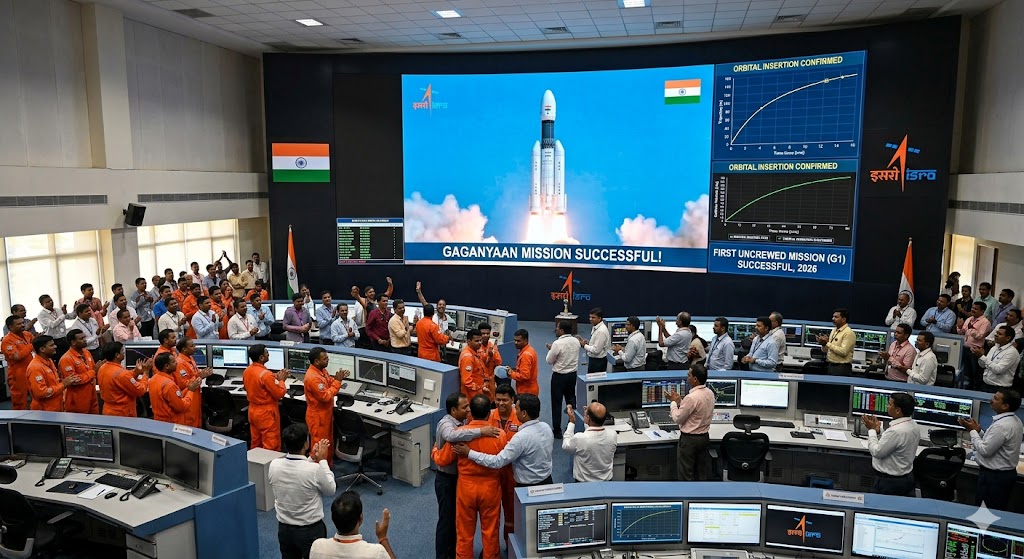
Scientists at the Indian Space Research Organisation (ISRO) celebrate the successful orbital insertion of the Gaganyaan mission.
Core Technologies Powering the Gaganyaan Mission
At the heart of every Gaganyaan mission success lies a suite of indigenous technologies developed over years of painstaking research. The Crew Module features a pressurised cabin with a state-of-the-art Environmental Control and Life Support System (ECLSS) that maintains temperature, humidity, oxygen levels, and removes carbon dioxide. Redundant power systems, including lithium-ion batteries and solar arrays on the Service Module, ensure uninterrupted operations.
The Crew Escape System deserves special mention. Capable of activating within milliseconds, it uses solid rocket motors to propel the Crew Module to a safe distance from a failing launcher. Abort tests conducted in previous years have already proven its efficacy from pad and in-flight conditions.
Re-entry technology forms another cornerstone. The Crew Module's heat shield, made from advanced ablative materials, must withstand temperatures exceeding 2,000°C while protecting occupants. Parachutes—woven from high-strength materials and rigorously tested—slow the module from hypersonic speeds to a gentle ocean touchdown.
Vyommitra, the humanoid robot developed by ISRO, will play a starring role in the G1 mission. Designed with female features and the ability to speak Hindi and English, Vyommitra will monitor cabin parameters, execute commands, and provide real-time feedback on microgravity effects. Her presence in the depressurised module during G1 will yield invaluable data without risking human lives.
The human-rated HLVM3 incorporates enhanced reliability features, including upgraded avionics, fault-tolerant software, and additional structural margins. Cryogenic engine procurement and integration discussions are also underway, ensuring the upper stage meets the exacting demands of human spaceflight.
Astronaut Selection, Training, and Mission MITRA
No Gaganyaan mission discussion is complete without the four Gaganyatris selected from the Indian Air Force: Group Captains Prasanth Balakrishnan Nair, Ajit Krishnan, Angad Pratap, and Wing Commander Shubhanshu Shukla. Shukla has already gained orbital experience as part of Axiom Mission 4 to the International Space Station in 2025, making him a valuable asset for the team.
Training encompasses centrifuge simulations for g-forces, neutral buoyancy pool exercises for spacewalk-like tasks, and survival drills. In early April 2026, ISRO launched Mission MITRA—a high-altitude wilderness training programme in Leh, Ladakh. This initiative tests the astronauts' mental resilience, physical endurance, and crew operability in extreme cold and low-oxygen conditions, mirroring potential emergency landing scenarios in remote terrains.
The Gaganyaan mission training regimen also includes sessions at specialised facilities abroad under international agreements, ensuring the crew masters every contingency. Psychological evaluations and team-building exercises foster the cohesion essential for a successful multi-day orbital mission.
Challenges Overcome and the Road Ahead for Gaganyaan Mission
Developing the Gaganyaan mission has not been without hurdles. Technical complexities in human-rating the launcher, qualifying life-support systems for extended durations, and coordinating multi-agency recovery operations demanded innovative solutions. Budgetary allocations and supply-chain refinements further tested the programme's pace.
Yet ISRO's systematic approach—iterative testing, data-driven decision-making, and close collaboration with DRDO, IAF, and Navy—has turned potential setbacks into stepping stones. The recent IADT-02 outcome and steady progress on G1 preparations exemplify this resilience.
Looking forward, G1 will demonstrate the full mission profile: launch, orbital insertion, re-entry, and recovery, all while carrying Vyommitra. Subsequent G2 and G3 missions will introduce pressurised operations and additional crew module configurations. Only after these uncrewed Gaganyaan mission successes will the crewed flight proceed, likely in 2027, carrying three Gaganyatris for a week-long stay in orbit.
Global Significance and India's Soaring Space Ambitions
The Gaganyaan mission success positions India as the fourth nation—after Russia, the United States, and China—to achieve sovereign human spaceflight. Beyond national pride, it opens avenues for commercial space services, satellite servicing, and future space station development. International partners are already expressing interest in collaborative payloads and astronaut exchanges.
Economically, the programme is catalysing private industry participation. Indian firms are supplying components ranging from parachutes to avionics, creating skilled jobs and strengthening the aerospace ecosystem. For students and researchers, the Gaganyaan mission serves as inspiration, aligning with India's vision of becoming a global space leader by 2040.
Conclusion: A New Chapter in India's Space Odyssey
The Gaganyaan mission has reached a mature phase marked by tangible successes such as the April 2026 IADT-02 triumph and thousands of qualifying tests. With the uncrewed G1 launch on the horizon and a clear pathway to crewed flight, ISRO stands poised to realise a dream decades in the making. Every milestone reinforces the message that India is ready—not just to reach space, but to do so safely, sustainably, and on its own terms.
As the world watches, the Gaganyaan mission continues to captivate imaginations and drive innovation. Its success will echo far beyond the launch pad, inspiring generations and cementing India's place among the stars. For the latest Gaganyaan mission updates, stay tuned to official ISRO channels and reliable space news sources.
Frequently Asked Questions
What is the primary significance of Gaganyaan Mission Success: ISRO's 2026 Milestones?
Gaganyaan Mission Success: ISRO's 2026 MilestonesIn a landmark development for India's space ambitions, the Indian Space Research Organisation (ISRO) has recorded another key achievement in the Gaganyaan mission. On April 10, 2026, the agency successfully completed the second Integrated Air Drop Test (IADT-02) at Sriharikota, validating critical parachute-based recovery systems for the Crew Module.
How does this development impact News?
This Gaganyaan mission success comes at a pivotal moment, as preparations for the first uncrewed orbital flight (G1) accelerate steadily. With over 8,000 ground tests already accomplished at a remarkable success rate, ISRO is methodically addressing every technical challenge to ensure crew safety before the historic crewed mission targeted for 2027.The Gaganyaan mission represents more than a technical feat; it embodies India's aspiration to join the elite group of nations capable of independent human spaceflight.
What are the key future projections to monitor?
As the country marks steady progress in 2026—often referred to in official circles as one of the dedicated "Gaganyaan years"—this article delves deep into the latest successes, underlying technologies, astronaut preparations, and the broader implications.