International Affairs• April 10, 2026• Global Edition
As Friday, April 10, 2026, unfolds in Islamabad, the global spotlight has turned to Pakistan’s capital for one of the most consequential diplomatic gatherings in recent Middle Eastern history. High-level US and Iranian delegations are preparing for formal peace talks scheduled to begin Saturday morning, following a fragile two-week ceasefire in the US-Israel-Iran war. Brokered swiftly by Pakistan, the truce has already been tested by continued Israeli military actions and threats around the Strait of Hormuz.
What began as coordinated US-Israeli strikes on Iranian targets in late February has escalated into a broader conflict claiming thousands of lives, disrupting global energy supplies, and reshaping alliances. Today’s developments in Islamabad represent a rare off-ramp, yet the risk of the ceasefire collapsing remains high. This article provides a comprehensive israel iran war update 2026, examining the background, Pakistan’s high-stakes role, the security challenges surrounding the Islamabad meeting, the drama unfolding around the Strait of Hormuz, and what the coming days may hold for the us israel iran war.
The roots of the current us israel iran war trace back to long-standing tensions that boiled over on February 28, 2026. In a series of rapid, large-scale operations, the United States and Israel launched hundreds of airstrikes targeting Iranian nuclear facilities, ballistic missile sites, air defenses, and senior leadership. The campaign, which US officials described as necessary to neutralize existential threats, resulted in significant Iranian casualties and infrastructure damage.
Iran responded with volleys of missiles and drone swarms aimed at Israeli cities and US bases across the region. Proxy forces, including Hezbollah in Lebanon, joined the fray, turning what started as a direct confrontation into a multi-front conflict. By early April, the death toll had climbed into the thousands, with civilian populations in Iran, Israel, Lebanon, and neighboring states bearing the brunt.
Oil markets reacted violently as Iran briefly disrupted shipping through the Strait of Hormuz, the chokepoint through which roughly one-fifth of global oil passes. Energy prices spiked, supply chains strained, and governments worldwide scrambled to assess the economic fallout. The war also triggered a wave of diplomatic maneuvering, with traditional allies on both sides urging de-escalation.
Enter Pakistan. In a surprising but calculated move, Prime Minister Shehbaz Sharif offered Islamabad as a neutral venue for negotiations. Both Washington and Tehran accepted, leading to the announcement of a two-week ceasefire on April 7-8. The agreement paused direct US and Iranian hostilities, but it explicitly left room for interpretation regarding Israeli operations against Hezbollah in Lebanon. This ambiguity has become the central fault line threatening the entire process.
The Fragile Two-Week Ceasefire and Its Immediate Challenges
The ceasefire, while welcomed by markets and exhausted populations, was never expected to hold without intensive diplomacy. Iranian officials have repeatedly warned that their “hands remain on the trigger,” signaling readiness to resume operations if core demands are ignored. For its part, the US has hailed the pause as a strategic victory, with President Donald Trump expressing optimism about a permanent deal emerging from the Islamabad talks.
Yet the fire is already flickering dangerously close to breaking out again. Israeli forces have continued intensive airstrikes and ground operations in southern Lebanon, targeting Hezbollah infrastructure. Israeli leaders maintain that these actions fall outside the US-Iran ceasefire framework, a position Tehran vehemently rejects. In retaliation, Iranian state media reported temporary closures of the Strait of Hormuz, prompting immediate White House condemnation and threats of renewed strikes on Iranian energy facilities.
This back-and-forth has created the precise scenario many analysts feared: a ceasefire that exists more on paper than on the battlefield. As one senior Western diplomat noted off the record, “The two-week window was always a gamble. Without rapid progress in Islamabad, the momentum could shift back toward open conflict within days.”
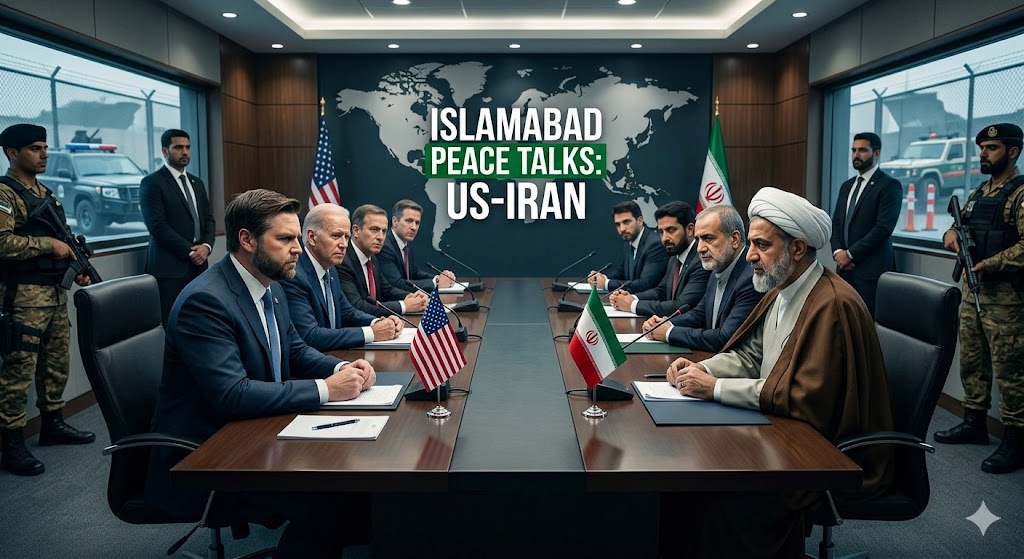
Inside a high-security conference room at the Serena Hotel in Islamabad, US and Iranian delegations begin formal negotiations on April 10, 2026. The high-stakes atmosphere emphasizes the tension and the critical need for a breakthrough to preserve the fragile ceasefire
Pakistan’s Bold Mediation and the Security Risks of the Islamabad Meeting
Pakistan’s decision to host the us iran talks in pakistan has thrust the South Asian nation into an unfamiliar role as regional peacemaker. Long viewed primarily through the lens of its own security challenges and complex relationships with neighbors, Islamabad has leveraged its diplomatic channels with both Washington and Tehran to facilitate the dialogue. Prime Minister Sharif described the invitation as a “contribution to global stability,” and Iranian President Masoud Pezeshkian personally thanked Pakistan for its efforts.
The Islamabad meeting, however, has come with substantial risks. Pakistani authorities declared a sudden two-day public holiday, cleared major thoroughfares, and deployed thousands of security personnel around the Serena Hotel and surrounding diplomatic zones. Reports indicate fighter jets were scrambled to secure airspace against potential threats, underscoring the high stakes. Intelligence sources suggest credible risks from militant groups opposed to any rapprochement between the US and Iran.
Why has Pakistan chosen to involve itself so deeply? Analysts point to multiple motivations: a desire to rebrand itself as a constructive global actor, economic incentives tied to potential post-conflict reconstruction contracts, and genuine concern that a wider Middle East war could destabilize Pakistan’s own borders and economy. By hosting the talks, Pakistan has positioned itself as indispensable, yet the move also exposes the country to criticism from domestic hardliners and external actors who view the mediation as overreach.
Social media in Pakistan has been abuzz with both pride and anxiety. Hashtags related to the “Islamabad peace summit” trend alongside concerns about national security. The government’s heavy-handed security measures—road closures, heightened checkpoints, and electronic jamming in key areas—have drawn mixed reactions but reflect the seriousness with which authorities view the event.
The Strait of Hormuz: Economic Lifeline or Strategic Weapon?
No discussion of the current israel iran war update would be complete without addressing the Strait of Hormuz. Iran’s repeated threats—and brief actual closures—of this narrow waterway have sent shockwaves through global energy markets. When Iranian officials signaled that shipping lanes would remain restricted until Israeli actions in Lebanon ceased, oil prices immediately climbed. Shipping companies rerouted vessels, insurance premiums skyrocketed, and Asian economies dependent on Gulf oil began contingency planning.
US officials have been unequivocal: any sustained closure is “completely unacceptable.” Vice President JD Vance, who is leading the American delegation to Islamabad, has reiterated that reopening the strait is a non-negotiable precondition for meaningful talks. Iran, meanwhile, frames its actions as legitimate self-defense in response to what it calls Israeli violations of the ceasefire spirit.
The economic ripple effects are already visible. Stock markets in energy-importing nations have wavered, while defense stocks and alternative energy shares have gained. For Pakistan, which imports much of its oil through the strait, the stakes are personal. The country’s own fuel reserves and rupee stability could be threatened if the waterway remains contested for long.
Israel’s Position: Strikes Continue as Talks Begin
Perhaps the most delicate element in the us israel iran war remains Israel’s stance. While Jerusalem has nominally agreed to the two-week ceasefire with Iran, Prime Minister Benjamin Netanyahu has made clear that operations against Hezbollah will persist. Israeli officials argue that Hezbollah’s rocket barrages and border incursions constitute a separate threat requiring independent action.
This position has infuriated Tehran, which views Hezbollah as an integral part of its defensive axis. Iranian leaders have warned that continued Israeli strikes could force them to abandon the Islamabad process entirely. On the ground, Lebanese health authorities report rising civilian casualties from intensified Israeli airstrikes, further inflaming regional sentiment.
US diplomats are walking a tightrope—supporting Israel’s security needs while urging restraint to preserve the broader ceasefire. The coming days in Islamabad will likely feature intense back-channel efforts to bridge this gap, possibly through parallel US-Israel-Lebanon discussions.
Global Implications and Expert Analysis
The human cost of the us israel iran war has been staggering, with thousands dead and millions displaced or economically devastated. Beyond the immediate battlefield, the conflict has strained international institutions, tested alliances, and accelerated shifts in global energy geopolitics.
Experts monitoring the islamabad meeting pakistan emphasize that success hinges on addressing not only immediate military de-escalation but also longer-term issues: Iran’s nuclear program, ballistic missile capabilities, and regional proxy networks. A durable agreement could reshape the Middle East for decades; failure risks a return to full-scale war with even higher stakes.
Economically, the war has already disrupted supply chains for critical minerals, aviation components, and technology. Recovery will depend heavily on the outcome of these talks. Socially, the conflict has fueled online narratives, memes, and information warfare on platforms worldwide, reflecting how modern conflicts play out as much in the digital realm as on the ground.
Looking Ahead: Prospects for the Islamabad Talks and Beyond
As delegations settle into their suites in Islamabad and final preparations wrap up for Saturday’s opening session, cautious optimism mixes with palpable tension. The two-week ceasefire window is short—too short, some argue, for comprehensive negotiations—but it provides a vital breathing space.
Key agenda items are expected to include verifiable reopening of the Strait of Hormuz, confidence-building measures on nuclear issues, and frameworks for addressing Lebanon. Pakistan’s continued facilitation, supported by quiet backing from China and other powers, may prove decisive.
For the average citizen in Tehran, Tel Aviv, or Washington, the hope is simple: that the fire nearly broken down in recent weeks does not reignite. Israel shows no sign of halting its operations entirely, yet the diplomatic channel opened in Islamabad offers a path forward that did not exist two months ago.
The coming hours and days will be critical. Whether the us iran peace talks deliver a breakthrough or merely buy more time remains to be seen. What is certain is that the world is watching Islamabad closely, aware that the decisions made here could determine the trajectory of the israel iran war for years to come.
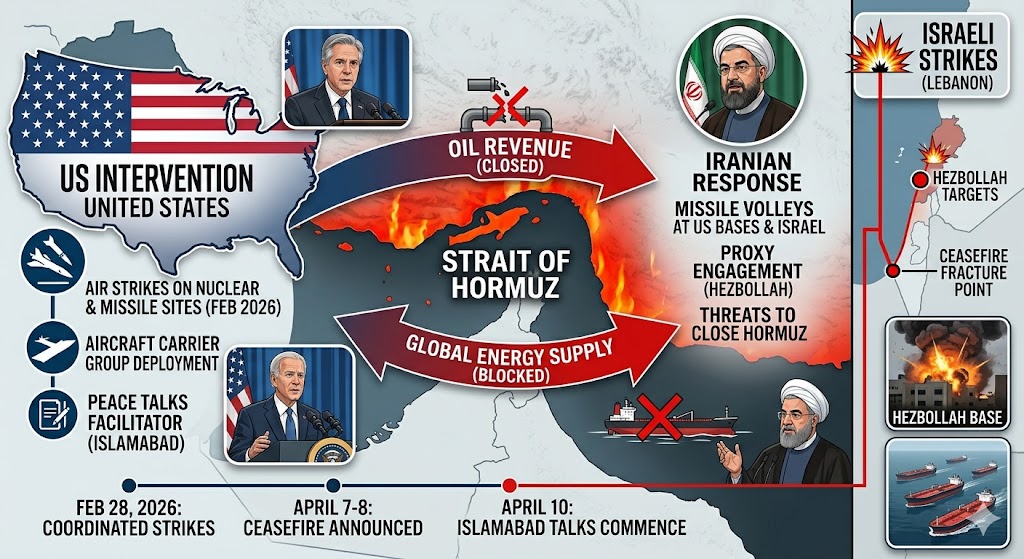
A detailed infographic illustrating the complex dynamic threatening the Islamabad talks. It maps the escalation: US-Israeli initial strikes, Iranian retaliation, the centrality of the Strait of Hormuz chokepoint, and the "Ceasefire Fracture Point" caused by continued Israeli strikes against Hezbollah in Lebanon, which Tehran views as a separate front.
Conclusion
The US-Israel-Iran war has tested the limits of diplomacy, military power, and economic resilience. Today, April 10, 2026, as ministers and envoys converge on Islamabad under heavy security, a rare opportunity for de-escalation presents itself. Pakistan’s courageous hosting of the talks, the fragile ceasefire’s survival despite Strait of Hormuz tensions and ongoing Israeli actions, and the high stakes for global stability all converge in this moment.
Progress will require pragmatism, compromise, and perhaps a measure of trust that has been in short supply. For now, the fire has not yet consumed the ceasefire, but the embers still glow. The outcome of the Islamabad meeting may well define whether the region steps back from the brink or slides once more into open conflict.
Frequently Asked Questions
What is the primary significance of US-Israel-Iran War: Islamabad Talks Amid Fragile Ceasefire?
As Friday, April 10, 2026, unfolds in Islamabad, the global spotlight has turned to Pakistan’s capital for one of the most consequential diplomatic gatherings in recent Middle Eastern history. High-level US and Iranian delegations are preparing for formal peace talks scheduled to begin Saturday morning, following a fragile two-week ceasefire in the US-Israel-Iran war.
How does this development impact International Affairs?
Brokered swiftly by Pakistan, the truce has already been tested by continued Israeli military actions and threats around the Strait of Hormuz. What began as coordinated US-Israeli strikes on Iranian targets in late February has escalated into a broader conflict claiming thousands of lives, disrupting global energy supplies, and reshaping alliances. Today’s developments in Islamabad represent a rare off-ramp, yet the risk of the ceasefire collapsing remains high.
What are the key future projections to monitor?
This article provides a comprehensive israel iran war update 2026, examining the background, Pakistan’s high-stakes role, the security challenges surrounding the Islamabad meeting, the drama unfolding around the Strait of Hormuz, and what the coming days may hold for the us israel iran war.Background of the US-Israel-Iran WarThe roots of the current us israel iran war trace back to long-standing tensions that boiled over on February 28, 2026.