Netaji Subhas Chandra Bose: INA Architect & Patriot Legacy
Early Life and Formative Years: Roots of a Revolutionary
Subhas Chandra Bose, affectionately known as Netaji, was born on January 23, 1897, in Cuttack, Odisha, into a prominent Bengali family. His father, Janakinath Bose, was a successful lawyer, and his mother, Prabhavati Devi, instilled strong values of discipline and patriotism. As the ninth of 14 siblings, young Subhas grew up in an environment that blended traditional Indian culture with modern education. He attended Ravenshaw Collegiate School and later Presidency College in Calcutta, where he excelled academically while developing a deep interest in philosophy and spirituality, particularly the teachings of Swami Vivekananda.
Bose's early exposure to India's colonial subjugation shaped his worldview. In 1916, a clash with a British professor at Presidency College led to his temporary rustication, highlighting his intolerance for racial arrogance. He completed his studies in philosophy in 1919 and, at his father's insistence, traveled to England in 1919 to prepare for the Indian Civil Service (ICS) examination. He cleared the exam with flying colors in 1920, ranking fourth, but resigned in 1921—a bold step that stunned his family and British authorities. In a letter to his brother, Bose wrote that serving the British Raj would betray his conscience. This decision marked the beginning of his lifelong commitment to India's freedom.
Returning to India amid the Non-Cooperation Movement led by Mahatma Gandhi, Bose joined the Indian National Congress. His fiery oratory and organizational skills quickly elevated him. By 1923, he became the president of the Bengal Provincial Congress. Imprisoned multiple times for his activism, Bose emerged as a leader of the radical wing of the Congress, advocating complete independence (Purna Swaraj) rather than dominion status. His health suffered due to repeated jail terms, yet his resolve only strengthened. These formative years laid the foundation for Bose's belief that passive resistance alone could not dislodge the British; active, armed resistance was essential.
Rise in Congress, Ideological Rift, and Formation of Forward Bloc
Bose's ascent within the Congress was meteoric. In 1938, he was elected President of the Indian National Congress at the Haripura session, defeating Gandhi's preferred candidate. He championed industrialization, scientific advancement, and a strong military for a future free India. Re-elected in 1939 at the Tripuri session, Bose clashed sharply with Gandhi and the Congress high command over strategies. Gandhi favored non-violence and gradual constitutional reforms, while Bose demanded immediate mass action and alliances against British imperialism, especially as World War II loomed.
The rift proved irreconcilable. Bose resigned in April 1939 and founded the All India Forward Bloc within the Congress to unite leftist and radical elements. Expelled from the Congress for indiscipline, he transformed the Forward Bloc into a platform for militant nationalism. His slogan, "Freedom is not given; it is taken," resonated with youth disillusioned by moderate approaches. Arrested again in 1940 under the Defence of India Rules, Bose began a hunger strike. Released on health grounds but placed under house arrest in Calcutta, he planned his daring escape.
On January 16, 1941, disguised as a Pathan named Muhammad Ziauddin with the help of his nephew Sisir Kumar Bose, Netaji slipped out of his Elgin Road home. Traveling via Kabul and Moscow, he reached Nazi Germany in April 1941. This audacious journey, one of the most dramatic in modern history, underscored Bose's determination to internationalize India's freedom struggle.
Escape to Axis Powers: Diplomacy in Exile and the Indian Legion
In Berlin, Bose established the Free India Centre and Azad Hind Radio, broadcasting anti-British messages in multiple Indian languages. He met Adolf Hitler and secured limited support, forming the Indian Legion from about 4,500 Indian prisoners of war captured in North Africa. Comprising soldiers who had fought for Britain, the Legion trained under German command but operated with Indian officers. Bose viewed alliances with Axis powers pragmatically: enemies of Britain could aid India's cause, despite ideological differences with fascism.
By 1943, disillusioned with slow progress in Europe, Bose sought Japanese assistance. In a perilous submarine voyage—first German U-boat to the Indian Ocean, then transfer to a Japanese vessel—he reached Tokyo in May 1943. Japanese Prime Minister Hideki Tojo welcomed him, seeing Bose as a tool to destabilize British Asia. On July 4, 1943, Bose assumed command of the Indian National Army (INA) in Singapore, revitalizing what was initially a smaller force under Rash Behari Bose and Captain Mohan Singh.
Building the Indian National Army: "Give Me Blood, and I Will Give You Freedom"
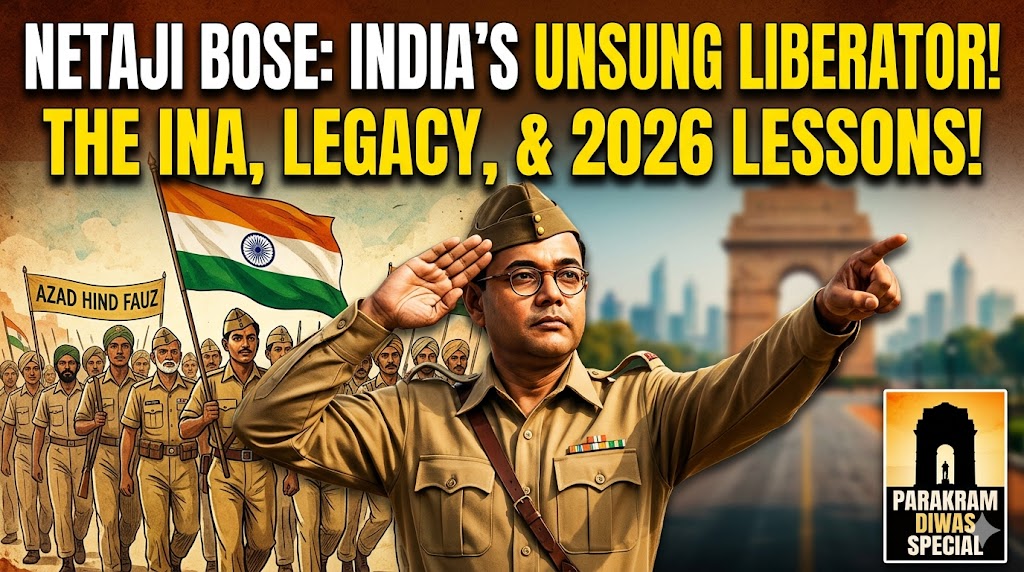
Netaji's revival of the INA remains his most enduring contribution. Comprising over 40,000 Indian POWs from the British Indian Army captured during the fall of Singapore in 1942, plus volunteers from Indian expatriate communities in Southeast Asia, the INA became a disciplined, motivated fighting force. Bose reorganized it into three divisions, emphasizing equality, discipline, and Indian command. Notably, he formed the all-women Rani of Jhansi Regiment under Captain Lakshmi Swaminathan (later Sahgal), a pioneering step in modern military history that empowered women in combat roles.
On October 21, 1943, Bose proclaimed the Provisional Government of Free India (Azad Hind) in Singapore. He served as Head of State, Prime Minister, and Minister of War. Recognized by nine countries including Japan, Germany, Italy, and Thailand, Azad Hind issued its own currency, stamps, and even planned a national bank. Bose's government controlled the Andaman and Nicobar Islands (renamed Shaheed and Swaraj Islands), marking the first liberated Indian territory.
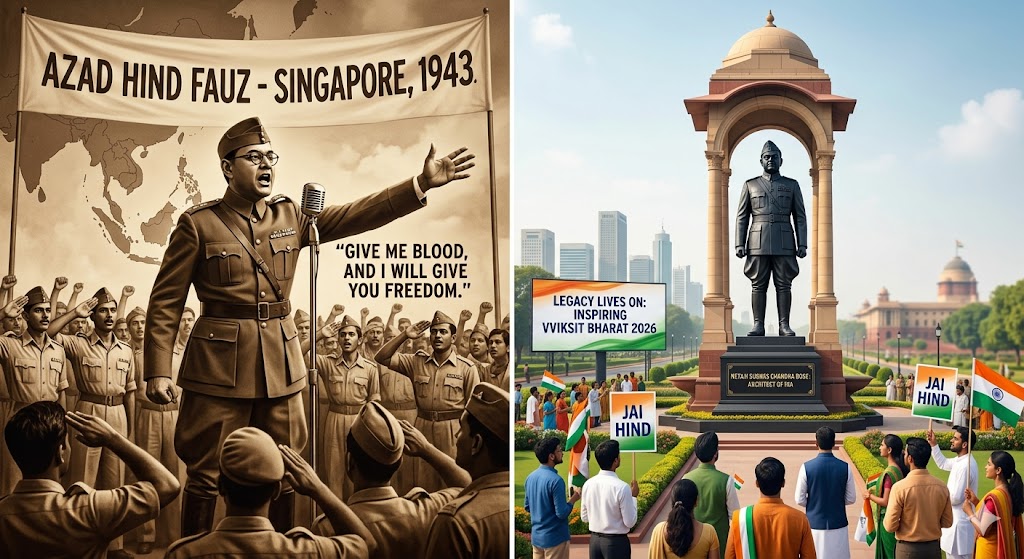
His iconic address—"Give me blood, and I will give you freedom"—galvanized millions. INA soldiers swore allegiance not to any foreign power but to India. Bose's army marched with the Japanese forces toward Imphal and Kohima in 1944, raising the tricolor on Indian soil at Moirang in Manipur. Though militarily defeated due to logistical challenges, monsoons, and Allied superiority, the INA's campaigns shattered the myth of British invincibility. The sight of Indian soldiers fighting under the national flag inspired widespread defiance back home.
Contributions to India's Freedom Struggle: Beyond the Battlefield
Every aspect of Subhas Chandra Bose's work accelerated India's independence. His international diplomacy exposed British vulnerabilities during World War II. The INA's exploits, broadcast via Azad Hind Radio, fueled underground resistance in India. Most crucially, the 1945-46 Red Fort trials of INA officers—Shah Nawaz Khan, Prem Sahgal, and Gurbaksh Singh Dhillon—sparked nationwide protests, mutinies in the British Indian Navy and Air Force, and eroded loyalty within the armed forces. British Prime Minister Clement Attlee later admitted that the INA trials, more than Gandhi's movements, hastened the decision to quit India.
Bose promoted unity across caste, religion, and region. INA ranks included Hindus, Muslims, Sikhs, and Christians serving side by side under "Jai Hind." He advocated women's empowerment, socialist economics, and scientific temper—ideas ahead of his time. His Forward Bloc pushed for radical land reforms and industrialization. Netaji's patriotism transcended personal ambition; he sacrificed a comfortable ICS career, family life, and safety for the nation.
The Mysterious Death and Enduring Controversies
On August 18, 1945, official reports claim Bose died in a plane crash in Taihoku (Taipei), Taiwan, en route to Manchuria and the Soviet Union. Severely burned, he succumbed in a hospital. However, this narrative has fueled decades of controversy. Successive inquiries—the Shah Nawaz Committee (1956), Khosla Commission (1974), and Mukherjee Commission (2006)—found inconsistencies: no DNA-tested remains, conflicting eyewitness accounts, and missing records. The Mukherjee Commission rejected the plane crash theory, suggesting Bose survived and lived incognito, possibly as "Gumnami Baba" in Faizabad until 1985.
Conspiracy theories abound: Soviet imprisonment, British assassination plots, or a staged death to evade Allied capture. Declassified files in 2016 and later revealed government secrecy, citing "foreign relations" concerns. As of 2026, the mystery persists, with families and researchers demanding full disclosure. These controversies have not diminished Netaji's stature but highlight the complexities of his legacy—alliances with Axis powers drew criticism for moral compromises, yet his anti-colonial pragmatism is increasingly contextualized.
National Recognition: The Statue and Beyond
In 2022, Prime Minister Narendra Modi unveiled a 28-foot monolithic black granite statue of Netaji at India Gate in New Delhi, sculpted by Arun Yogiraj. Placed under the historic canopy, it symbolizes national unity and replaces colonial-era symbols. Parakram Diwas, observed on January 23 since 2021, honors Bose's valor. Statues, museums, and the Netaji Subhas Chandra Bose Aapda Prabhandan Puraskar underscore his place in India's collective memory. (Note: While some narratives evoke themes of "unity" through his inclusive INA, the iconic India Gate statue stands as a beacon of patriotic resolve.)
Lessons from Netaji for India in 2026: Patriotism That Still Resonates
As India stands in 2026, amid global challenges like geopolitical tensions, economic reforms, and youth aspirations, Netaji's life offers profound lessons. His unyielding patriotism—placing nation above self—remains a guiding force. In an era of divisive politics, Bose's emphasis on unity ("One nation, one army") inspires efforts toward social cohesion. His leadership model—decisive action, discipline, and vision—teaches today's youth that courage means creating opportunities, not waiting for them.
Netaji's self-reliance ethos aligns with Atmanirbhar Bharat. He envisioned a strong, industrialized India free from foreign dependence. For development, his socialist yet pragmatic approach suggests balanced growth: military strength, scientific education, and inclusive policies. If Netaji had led post-1947 India, historians speculate a more disciplined, militarily robust nation with faster infrastructure and reduced bureaucratic inertia. His forward-thinking on women's roles and technology could have accelerated gender parity and innovation, fostering a "developed India" earlier than 2047 goals. While democracy might have evolved differently—Bose favored authoritarian efficiency during crises—his integrity would likely have minimized corruption and dynastic politics.
The Unfulfilled Dream: Chance to Become India's First Prime Minister
Netaji came closest to premiership through the Azad Hind Government in 1943, recognized internationally as India's provisional sovereign authority. He was its elected Head of State and Prime Minister. Yet, for independent India in 1947, fate intervened. Bose's reported death in 1945 preceded freedom by two years. Ideological clashes with Congress leadership—his militant path versus Gandhi-Nehru's non-violence and socialism—marginalized him. Post-war, Nehru's popularity and Congress dominance sealed the transition. Bose's kin and supporters argue his contributions were underplayed to favor a single narrative. Had he survived, many believe his charisma could have unified factions, potentially altering Partition's tragedy and accelerating progress. Speculation aside, his absence left a vacuum filled by others, but his spirit endures.
Conclusion: An Eternal Flame for India's Progress
Subhas Chandra Bose's journey—from ICS resignation to INA commander—embodies sacrifice, strategic brilliance, and unwavering love for India. His army united diverse Indians under one banner, his government in exile gave form to free India, and his trials ignited the final push for independence. Controversies around his death only amplify his mystique, reminding us that true heroes transcend official histories.
In 2026, as India pursues Viksit Bharat, Netaji's lessons in courage, unity, and bold leadership offer a roadmap. His patriotism still stirs the soul, urging citizens to prioritize nation-building. By emulating his discipline and vision, India can forge a future of strength, equity, and global leadership. Netaji did not just fight for freedom; he redefined what it means to serve. Jai Hind—his call echoes louder than ever.