Third World Countries: History, Economy & Global Role
Current Affairs• April 10, 2026• Global Edition
Third World Countries Today
The term “third world countries” still appears frequently in searches, yet its meaning has evolved dramatically since its creation. Originally a Cold War label for nations outside the capitalist and communist blocs, it now broadly refers to developing countries or the Global South—economies working to overcome historical disadvantages while playing an increasingly central role in the world economy.
In 2026, these nations encompass the majority of the planet’s population and drive most global growth. According to recent World Bank and IMF data, emerging market and developing economies (often called the Global South) account for roughly 50 percent of world GDP on a purchasing-power-parity basis and contribute over 60 percent of global economic expansion. Far from being peripheral, third world countries supply critical resources, labor, consumer markets, and innovative solutions that keep the global economy functioning.
This article examines every facet: the historical roots of the term, geographical scope, economic evolution, specific contributions to worldwide development, persistent challenges, and the promising pathways shaping their future. By understanding these dynamics, we see how third world countries have transformed from post-colonial strugglers into indispensable partners in global progress.
The Historical Origins of the Term “Third World”
The phrase “third world” was coined in 1952 by French demographer Alfred Sauvy in an article titled “Three Worlds, One Planet,” published in the magazine L’Observateur. Sauvy drew an analogy to France’s pre-revolutionary “Third Estate”—the common people who were neither nobility nor clergy but formed the bulk of society. He described a “third world” of countries that were neither aligned with the capitalist First World (led by the United States and Western Europe) nor the communist Second World (the Soviet Union and its Eastern Bloc allies).
At the time, the Cold War dominated international relations. Newly independent nations in Asia, Africa, and Latin America—emerging from colonial rule after World War II—refused to join either superpower camp. Many joined the Non-Aligned Movement, formalized at the 1961 Belgrade Conference. The term highlighted their political independence and economic marginalization. These countries played a small role in global trade, suffered from underdevelopment, and faced the dual burdens of poverty and geopolitical pressure.
Initially, the label carried no inherent judgment of wealth or development level. Countries like Switzerland or Sweden could technically fit the non-aligned definition. However, simplistic interpretations quickly linked “third world” to poverty, instability, and underdevelopment. By the 1960s and 1970s, the term became shorthand for the poorest regions, especially in Africa, South Asia, and parts of Latin America. It gained traction in academic, political, and media circles, often carrying connotations of backwardness that many leaders in those nations later rejected as patronizing.
The end of the Cold War in the early 1990s rendered the original geopolitical meaning obsolete. The Second World largely disappeared, and the binary of developed versus developing took over. Today, scholars and international organizations prefer neutral terms such as “developing countries,” “low- and middle-income economies,” or “Global South.” Yet “third world countries” persists in everyday language because it evokes a shared history of colonialism, independence struggles, and the quest for self-reliance.
Evolution and Modern Classification of Developing Countries
Contemporary classification relies on objective economic metrics rather than Cold War politics. The World Bank’s fiscal year 2026 income groupings, based on 2024 Gross National Income (GNI) per capita using the Atlas method, provide the clearest framework:
Low-income economies: $1,135 or less
Lower-middle-income: $1,136 to $4,495
Upper-middle-income: $4,496 to $13,935
High-income: above $13,935
Most third world countries fall into the first three categories, collectively labeled developing or emerging economies. The United Nations maintains a separate list of Least Developed Countries (LDCs), currently around 46 nations, primarily in sub-Saharan Africa, with additional entries in Asia and the Pacific. These face the steepest structural obstacles.
The IMF further groups “emerging market and developing economies” (EMDEs), which include powerhouses like China and India alongside smaller states. The Global South concept, popularized in the 1960s and refined today, emphasizes shared experiences of colonialism and a collective push for equitable global systems. It is not strictly geographical—Australia is in the Global North despite its southern location—yet it captures the reality that the majority of humanity lives in nations still catching up economically.
In 2026, shifts continue. Several countries, including Cabo Verde, Costa Rica, Namibia, and Samoa, recently moved up income brackets due to sustained growth and policy reforms. These transitions illustrate that the “third world” label is not static; many nations have progressed remarkably while others remain vulnerable.
Geographical Scope and Regional Diversity
Third world countries span every continent except Antarctica, but concentration is highest in three regions:
Sub-Saharan Africa remains home to the largest number of low-income nations. Countries like Nigeria, Ethiopia, Democratic Republic of Congo, and Kenya represent immense diversity—resource-rich yet challenged by infrastructure gaps. Africa’s youthful population (median age under 20 in many states) offers a demographic dividend if harnessed through education and jobs.
South and Southeast Asia showcase rapid transformation. India, Bangladesh, Vietnam, and Indonesia have lifted hundreds of millions out of poverty through manufacturing, services, and digital economies. South Asia alone drives significant global growth projections for 2026.
Latin America and the Caribbean feature upper-middle-income leaders such as Brazil, Mexico, and Colombia alongside smaller economies. The region’s strengths lie in agriculture, mining, and services, though inequality and debt constrain potential.
Smaller clusters exist in the Pacific Islands, the Middle East (non-oil states), and Central Asia. This diversity means no single narrative fits all third world countries. Some export oil and minerals; others specialize in textiles, tourism, or information technology. What unites them is the shared legacy of colonial extraction and the ongoing effort to build resilient, inclusive economies.
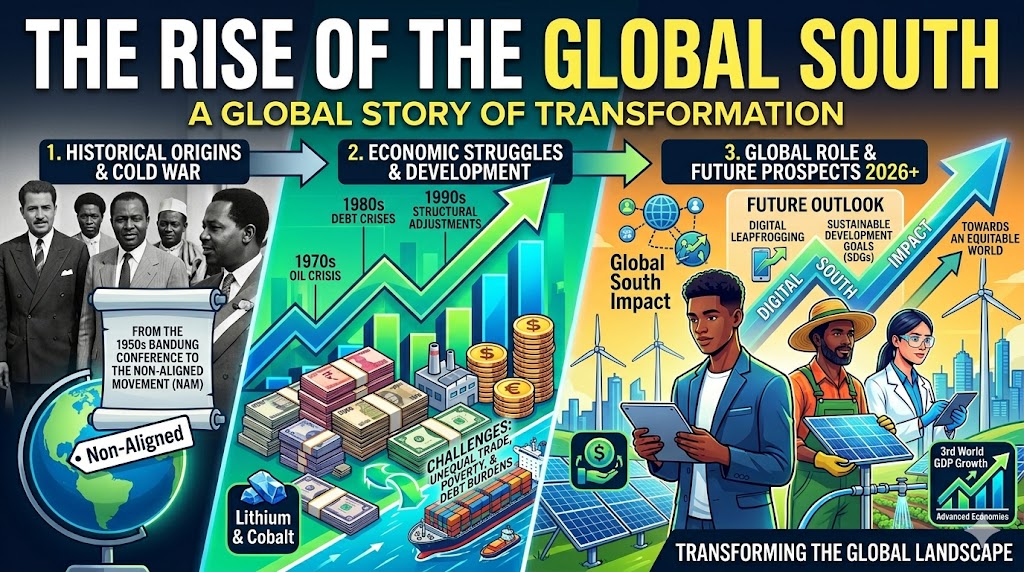
The Rise of the Global South: A Global Story of Transformation," visually charts the historical journey and current economic significance of "third world" and developing nations. Divided into three distinct but connected sections—"Historical Origins & Cold War," "Economic Struggles & Development," and "Global Role & Future Prospects 2026+"—it breaks down the key periods and influences
Economic History: From Colonialism to Independence
The economic story of third world countries begins with colonialism. European powers from the 15th to mid-20th century extracted raw materials—rubber, minerals, cash crops—while suppressing local industry. Independence waves after 1945 brought hope but also challenges: weak institutions, arbitrary borders, and dependence on primary commodity exports.
In the 1950s–1970s, many adopted import-substitution industrialization, protecting domestic markets. Results varied; some built basic industries, but inefficiencies and debt often followed. The 1980s debt crisis hit hard, forcing structural adjustment programs from the IMF and World Bank that emphasized liberalization, privatization, and fiscal austerity—sometimes at the cost of social services.
The 1990s and 2000s brought globalization. Trade liberalization allowed developing countries to double their share of global exports to around 30 percent. China’s rise as “factory of the world” created supply-chain opportunities for others. Commodity booms in the 2000s fueled growth across Africa and Latin America until the 2008 financial crisis and subsequent slowdowns.
Post-2010, digital technology and mobile money (exemplified by Kenya’s M-Pesa) began reshaping economies. The COVID-19 pandemic exposed vulnerabilities but also accelerated remote work, e-commerce, and vaccine diplomacy among Global South nations. By 2026, third world countries have weathered multiple shocks—pandemics, wars, inflation—while steadily increasing their global economic footprint.
Current Economic Landscape and Contributions to Global Development
In 2026, the economic weight of developing countries is undeniable. IMF and UNCTAD projections show EMDEs growing at approximately 4 percent, compared to 1.5 percent for advanced economies. Global growth hovers around 2.7–3.3 percent, with the Global South providing the majority of the increment. China and India alone are expected to contribute over 40 percent of worldwide GDP expansion in 2026.
Trade and Resources: Developing countries supply the raw materials essential for modern technology—lithium, cobalt, rare earths from Africa and Latin America power electric vehicles and renewable energy. Manufactures now dominate their export baskets; textiles from Bangladesh, electronics assembly from Vietnam, and automobiles from Mexico integrate deeply into global value chains. South-South trade has more than doubled since 2007, reaching $5.6 trillion by 2023 and continuing to expand, reducing reliance on traditional Northern markets.
Remittances: These private flows form a lifeline. In 2024, remittances to low- and middle-income countries reached an estimated $685 billion, exceeding foreign direct investment and official development assistance combined. For nations like Nepal, Tonga, or El Salvador, remittances exceed 20–40 percent of GDP. They fund education, healthcare, and small businesses, directly reducing poverty and stabilizing currencies during crises.
Consumer Markets and Innovation: The rising middle class in third world countries drives global demand for everything from smartphones to automobiles. Frugal innovation—affordable solutions tailored to resource constraints—spills northward. India’s low-cost pharmaceuticals, Kenya’s mobile fintech, and Brazil’s biofuels demonstrate how necessity breeds globally relevant technology.
Labor and Demographics: With younger populations, these nations supply both migrant workers (generating remittances) and a future workforce for aging Northern economies. Their integration into global systems supports sustainable development goals, from poverty reduction to climate action.
Collectively, third world countries have become engines of economic development, not just recipients. Their growth lifts global commodity prices, diversifies supply chains, and fosters resilience against shocks in any single region.
Persistent Challenges and Structural Barriers
Despite progress, significant hurdles remain. High public debt burdens many economies; debt servicing in some cases exceeds spending on health or education. Climate change disproportionately affects vulnerable nations through droughts, floods, and rising seas, with limited fiscal space for adaptation.
Geopolitical tensions, trade fragmentation, and protectionism threaten export markets. Access to affordable finance is constrained by credit ratings that sometimes overlook long-term potential. Inequality within countries persists, with urban-rural divides and gender gaps limiting inclusive growth. Governance challenges, corruption, and infrastructure deficits in the poorest states slow advancement.
The 2026 outlook highlights these risks: slowing global trade momentum, elevated borrowing costs, and uneven recovery from recent shocks. Yet many leaders in the Global South view these as catalysts for deeper regional cooperation, such as the African Continental Free Trade Area (AfCFTA), which promises to create the world’s largest single market by population.
Success Stories and Pathways Forward
Notable achievements prove transformation is possible. Vietnam has moved from one of the world’s poorest to lower-middle income through export-led industrialization. Bangladesh’s garment sector and microfinance model have dramatically reduced poverty. Rwanda has become a tech and services hub in East Africa. India’s digital public infrastructure (Aadhaar, UPI) enables financial inclusion at massive scale.
Common success factors include investment in human capital (education and health), macroeconomic stability, openness to trade and investment, and pragmatic policy experimentation. Regional integration, South-South partnerships, and targeted use of remittances for productive investment further accelerate development.
Looking ahead, digitalization, green energy transitions, and artificial intelligence offer leapfrogging opportunities. Many third world countries are adopting renewable technologies faster than anticipated, positioning themselves in the global clean economy. Policy priorities for 2026 and beyond include debt relief, climate finance, technology transfer, and inclusive governance.
From their origins as non-aligned nations in a bipolar world to their current status as dynamic contributors to global prosperity, third world countries have written a story of resilience and rising influence. They are no longer on the periphery; they shape the center—supplying resources, talent, markets, and ideas that sustain worldwide economic development.
In 2026, as advanced economies face demographic headwinds and slower growth, the Global South’s vitality becomes even more critical. Their success is not zero-sum; when developing countries thrive, the entire planet benefits through expanded trade, innovation, and stability.
The journey continues. With supportive international policies, domestic reforms, and collective determination, third world countries will keep driving progress toward a more equitable and sustainable global economy. Their history of overcomin adversity equips them well for the opportunities—and challenges—of the decades ahead.
Frequently Asked Questions
What is the primary significance of Third World Countries: History, Economy & Global Role?
Third World Countries TodayThe term “third world countries” still appears frequently in searches, yet its meaning has evolved dramatically since its creation. Originally a Cold War label for nations outside the capitalist and communist blocs, it now broadly refers to developing countries or the Global South—economies working to overcome historical disadvantages while playing an increasingly central role in the world economy.In 2026, these nations encompass the majority of the planet’s population and drive most global growth.
How does this development impact Current Affairs?
According to recent World Bank and IMF data, emerging market and developing economies (often called the Global South) account for roughly 50 percent of world GDP on a purchasing-power-parity basis and contribute over 60 percent of global economic expansion. Far from being peripheral, third world countries supply critical resources, labor, consumer markets, and innovative solutions that keep the global economy functioning.This article examines every facet: the historical roots of the term, geographical scope, economic evolution, specific contributions to worldwide development, persistent challenges, and the promising pathways shaping their future.
What are the key future projections to monitor?
By understanding these dynamics, we see how third world countries have transformed from post-colonial strugglers into indispensable partners in global progress.The Historical Origins of the Term “Third World”The phrase “third world” was coined in 1952 by French demographer Alfred Sauvy in an article titled “Three Worlds, One Planet,” published in the magazine L’Observateur.