"Indus Valley Civilization: Urban Planning Marvels"
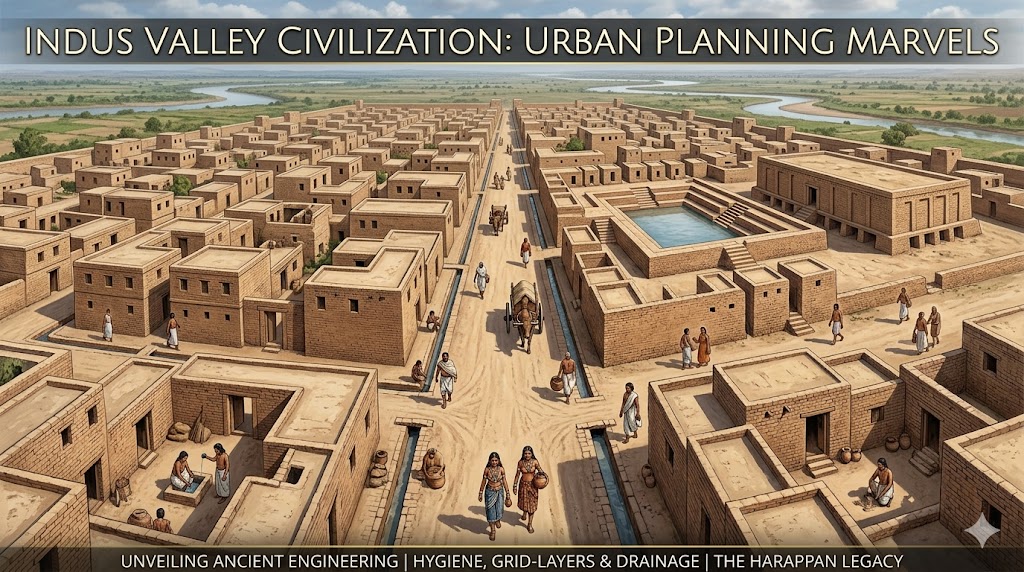
The Indus Valley Civilization, often hailed as one of the world's earliest urban societies, flourished between approximately 3300 BCE and 1300 BCE along the fertile plains of the Indus River and its tributaries in present-day Pakistan and northwest India. At its peak during the Mature Harappan phase (2600–1900 BCE), this remarkable culture supported over 1,000 settlements, with major cities like Harappa, Mohenjo-Daro, Lothal, Dholavira, and Rakhigarhi housing tens of thousands of inhabitants each. What sets the Indus Valley Civilization apart is not monumental palaces or towering temples, but its unparalleled focus on practical, egalitarian urban planning that prioritised hygiene, order, and sustainability.
Archaeologists marvel at how this Bronze Age society achieved such sophistication without evidence of a centralized monarchy or large-scale warfare. Instead, the Indus Valley Civilization demonstrated a highly organized urban state and township planning system that influenced daily life, trade, and community well-being. From meticulously laid-out streets to an advanced drainage system that rivaled many modern setups, the civilization's engineering prowess continues to inspire awe. Yet, alongside these achievements lie enduring mysteries: an undeciphered script, elusive religious practices, and a gradual decline that still sparks scholarly debate.
This article delves deep into the urban planning marvels of the Indus Valley Civilization, explores its drainage innovations, examines the enigmatic Indus script, uncovers what gods its people worshipped, details everyday attire, and analyzes theories behind its decline. Drawing from archaeological sources, we also highlight practical lessons for today's India—particularly in engineering education, diploma training programs, and smart city initiatives. In an era of rapid urbanization and climate challenges, the Indus Valley Civilization offers a blueprint for resilient, eco-friendly town planning that remains strikingly relevant.
Historical Context and Major Sites of the Indus Valley Civilization
The roots of the Indus Valley Civilization trace back to earlier Neolithic settlements like Mehrgarh around 7000 BCE, evolving into the Early Harappan phase by 3500 BCE. By the mature period, standardized weights, measures, and brick sizes across vast distances point to a sophisticated administrative network. Key sites reveal the civilization's geographic spread: Harappa in Punjab (Pakistan) with its granaries and citadel; Mohenjo-Daro in Sindh, famous for the Great Bath; Lothal in Gujarat, boasting the world's earliest known dockyard; Dholavira with its advanced water reservoirs; and Rakhigarhi, one of the largest settlements.
These cities were not haphazardly built. The Indus Valley Civilization's urban state reflected deliberate planning, dividing settlements into a raised citadel (likely for public or elite functions) and a lower town for residential and commercial use. Baked bricks—uniform in size and fired for durability—formed the backbone of construction, resistant to floods and wear. This level of standardization across hundreds of kilometers underscores a shared civic vision, free from the overt hierarchy seen in contemporary Egypt or Mesopotamia.
Excavations since the 1920s, led by figures like John Marshall and R.D. Banerji, have unearthed artifacts that paint a picture of a peaceful, trade-oriented society. Bead factories in Lothal and seals found as far as Mesopotamia highlight extensive commerce. Yet, the absence of royal tombs or grand monuments suggests a more collective governance model, where urban planning served the common good.
Pioneering Urban Planning and Township Design in the Indus Valley Civilization
The urban planning of the Indus Valley Civilization stands as one of history's greatest engineering feats. Cities followed a gridiron layout, with streets intersecting at right angles—north-south and east-west orientations optimized for ventilation and sunlight. Main thoroughfares were as wide as 10 meters, lined with houses built from standardized baked bricks. This methodical township planning ensured efficient movement, waste management, and expansion potential.
In Mohenjodaro and Harappa, the citadel housed public structures like the Great Bath—a waterproofed pool possibly used for ritual cleansing—and large granaries for food storage. Lower towns featured multi-story homes with courtyards, private wells, and bathrooms. Remarkably, no two houses were identical in layout, yet all adhered to uniform building codes, reflecting a balance between individual needs and collective standards.
What made this planning so commendable was its foresight. Houses opened onto narrow lanes rather than main roads, reducing noise and dust while maintaining privacy. Public wells and bathing platforms promoted hygiene and social interaction. Lothal's dockyard integrated maritime trade with urban infrastructure, while Dholavira's water conservation systems adapted to arid conditions through reservoirs and check dams.
This approach to urban state and township planning prioritize functionality over ostentation. Unlike later empires focused on grandeur, the Indus Valley Civilization emphasized livability—proof that advanced engineering can thrive without authoritarian excess. Modern architects often cite these grid systems as precursors to contemporary city designs, where traffic flow and zoning prevent chaos.
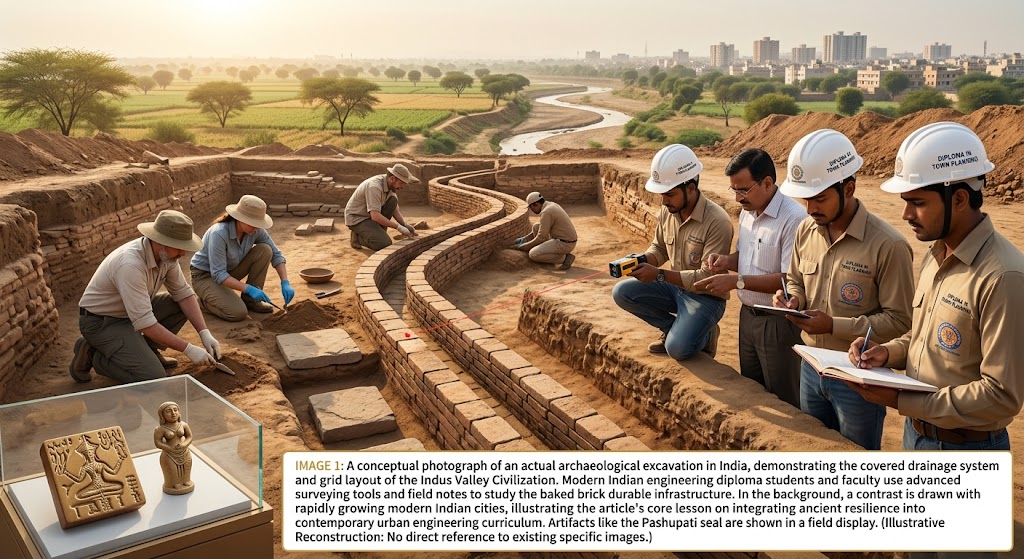
Modern Indian engineering students and archaeologists conduct a field study at an Indus Valley excavation site. The scene highlights the intersection of ancient wisdom and modern technology, as researchers use advanced surveying tools to analyze the civilization’s legendary brick-lined drainage systems and grid layouts. By studying these 5,000-year-old urban marvels, today’s engineers gain vital insights into sustainable town planning and resilient infrastructure for 21st-century smart cities.
The Revolutionary Drainage System of the Indus Valley Civilization
No feature of Indus Valley Civilization urban planning captures imagination quite like its drainage system. Every house is connected to an underground network of covered drains made from baked bricks and mortar. These street drains, sloped for gravity flow, featured removable stone slabs for maintenance—essentially ancient manholes. Soak pits and settling tanks filtered waste before it reached rivers, preventing contamination.
In Mohenjo-Daro, drains ran along major streets, with vertical chutes from rooftops directing rainwater. Homes included latrines and bathing areas, with wastewater channeled directly into the system. This sophistication surpassed many 19th-century European cities and addressed sanitation at a scale unmatched until Roman times.
The drainage system rose alongside urban growth, evolving from simple ditches in early phases to a city-wide grid. Archaeologists note how streets were slightly elevated and paved, directing runoff efficiently. This not only curbed disease but also conserved water through recycling and minimal waste. In Lothal and Dholavira, similar systems integrated with ports and reservoirs, showcasing adaptive engineering for diverse environments.
Such ingenuity highlights why the Indus Valley Civilization's town planning remains a benchmark. It demonstrated that true urban excellence lies in invisible infrastructure—sewers and pipes that sustain health and prosperity.
The Enigmatic Indus Script: A Lingering Mystery
Amid these physical marvels lies the undeciphered Indus script, etched on over 4,000 steatite seals, pottery, and tablets. Comprising around 400 distinct signs—often in short sequences of five symbols—the script appears on trade goods, possibly denoting ownership, names, or titles. Found across sites from Harappa to Lothal, it shows remarkable consistency over centuries, suggesting a stable administrative language.
Despite decades of scholarly effort, including AI-assisted analysis, the Indus script remains a puzzle. No bilingual inscription (like Egypt's Rosetta Stone) exists, and inscriptions are too brief for statistical decipherment. Debates rage: Was it a full writing system encoding a Dravidian or Indo-Aryan language, or merely proto-writing for symbols? Recent efforts, such as a 2025 prize announced by Tamil Nadu's Chief Minister for its decoding, underscore ongoing fascination.
The script's mystery adds intrigue to Indus Valley Civilization studies. Seals often depict animals like unicorns or bulls alongside signs, hinting at religious or commercial use. Until deciphered, it guards secrets of governance and daily life, reminding us that advanced engineering coexisted with intellectual enigmas.
Religious Beliefs and Deities Worshipped in the Indus Valley Civilization
Religion in the Indus Valley Civilization appears nature-oriented and egalitarian, lacking grand temples. Terracotta figurines suggest worship of a Mother Goddess, symbolizing fertility, with exaggerated hips and breasts. The famous Pashupati seal from Mohenjodaro portrays a horned figure seated in a yogic pose, surrounded by animals—interpreted by many as proto-Shiva, "Lord of Beasts."
People likely venerated trees (pipal), animals, and natural forces like water and fire. The Great Bath implies ritual bathing, while yoni-like symbols point to fertility cults. No evidence of priest-kings or large-scale sacrifices exists; instead, household shrines and seals indicate personal devotion.
This blend of animism and proto-Hindu elements influenced later Indian traditions. The Indus Valley Civilization's gods reflected harmony with the environment—a philosophy mirrored in their sustainable planning.
Daily Life and Clothing in the Indus Valley Civilization
Artifacts reveal a vibrant daily life. Men typically wore a dhoti-like garment wrapped around the waist, sometimes passed between the legs, paired with shawls or robes over one shoulder (as seen in the "Priest-King" statue). Turbans adorned some heads. Women donned knee-length skirts, often with elaborate jewelry—bead necklaces, bangles, earrings, and anklets crafted from gold, copper, and semi-precious stones. Cotton, domesticated early here, formed the primary fabric, dyed in vibrant hues.
Terracotta figures and seals depict elaborate hairstyles and headdresses. Both genders adorned themselves with ornaments, suggesting a society that valued aesthetics alongside utility. This attire suited the hot climate while reflecting trade networks supplying beads from distant regions.
The Mysterious Decline of the Indus Valley Civilization: Theories and Evidence
The decline of the Indus Valley Civilization around 1900–1300 BCE was not a sudden cataclysm but a gradual transformation. Cities were abandoned, trade dwindled, and populations shifted eastward. Early theories blamed Aryan invasions (now largely debunked due to lack of violence evidence) or floods from tectonic shifts.
Archaeological sources now point to climate change as a primary driver. Recent 2025 studies, including research from IIT Gandhinagar published in Communications Earth & Environment, reveal four prolonged droughts (each lasting over 85 years) between 4450 and 3400 years ago. Monsoon weakening reduced rainfall by 10–20%, drying rivers like the Ghaggar-Hakra (ancient Saraswati). Temperatures rose slightly, stressing agriculture and water systems.
Communities adapted by migrating to wetter Ganges plains or coastal areas, leading to deurbanization. Deforestation and over-irrigation may have compounded issues. Unlike dramatic collapses elsewhere, the Indus Valley Civilization's decline was adaptive—skills persisted in rural forms, influencing Vedic culture.
Post-decline, archaeological layers show continuity in pottery and crafts but loss of urban complexity. This slow fade, supported by lake sediments and stalagmites, underscores environmental vulnerability.
Insights from Archaeological Sources on Planning and Decline
Excavations by the Archaeological Survey of India and international teams provide layered evidence. Uniform artifacts across sites confirm centralized planning standards. Decline strata reveal silt from floods in some areas, but widespread drought signatures dominate recent analyses. These sources affirm the civilization's resilience: even in decline, people repurposed infrastructure rather than abandoning knowledge entirely.
Timeless Lessons for Modern India: Engineering, Diploma Training, and Sustainable Urban Planning
The Indus Valley Civilization's town planning offers profound takeaways for contemporary India. Its drainage system inspires modern sanitation projects, as seen in Swachh Bharat initiatives. Grid layouts and water harvesting at Dholavira align with smart city goals under AMRUT and Smart Cities Mission.
For engineering and diploma training, curricula could integrate IVC case studies. Students in civil and environmental engineering programs might analyze baked-brick durability or gravity-fed drains, fostering sustainable design skills. Diploma courses in town planning could emphasize standardization and community-focused infrastructure—lessons absent in many rapid-growth cities facing flooding and pollution.
India can learn flood-resistant planning, rainwater conservation, and equitable urban zoning. By embedding these in polytechnic syllabi, future engineers will build resilient cities amid climate change. The Indus Valley Civilization proves that advanced engineering serves people, not just profit— a model for eco-friendly development in 21st-century India.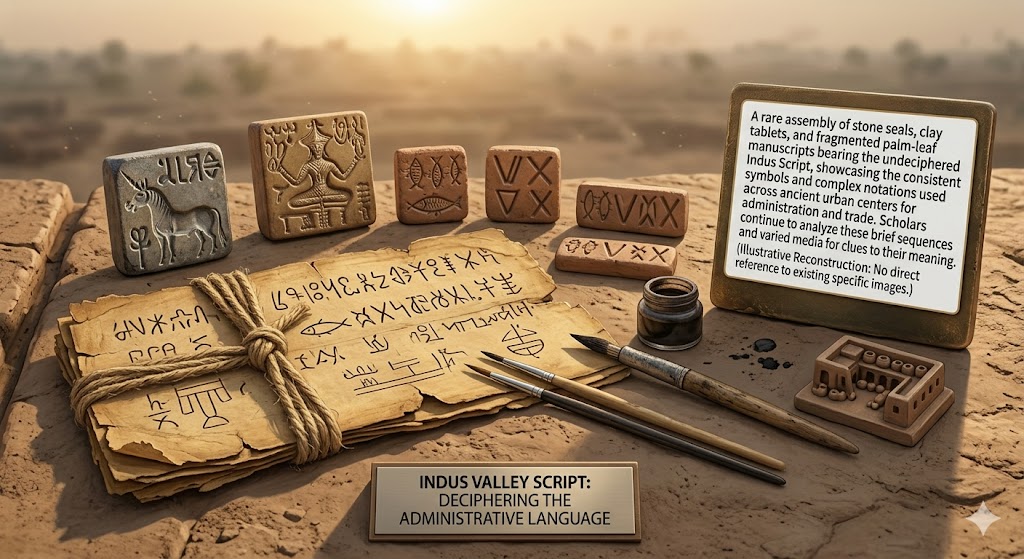
INDUS VALLEY MANU SCRIPTS: Deciphering the Administrative Language
Conclusion
The Indus Valley Civilization's urban planning, drainage mastery, mysterious script, and subtle religious life paint a portrait of innovation and harmony. Its gradual decline, illuminated by archaeology and recent climate studies, warns of environmental limits. Yet, its legacy endures as a source of pride and inspiration.
As India urbanizes, embracing these ancient principles—through education, policy, and practice—can forge sustainable futures. The marvels of Harappa and Mohenjodaro remind us: true progress lies in thoughtful planning that respects both people and planet. By studying this extraordinary civilization, we honor our past while engineering a wiser tomorrow.