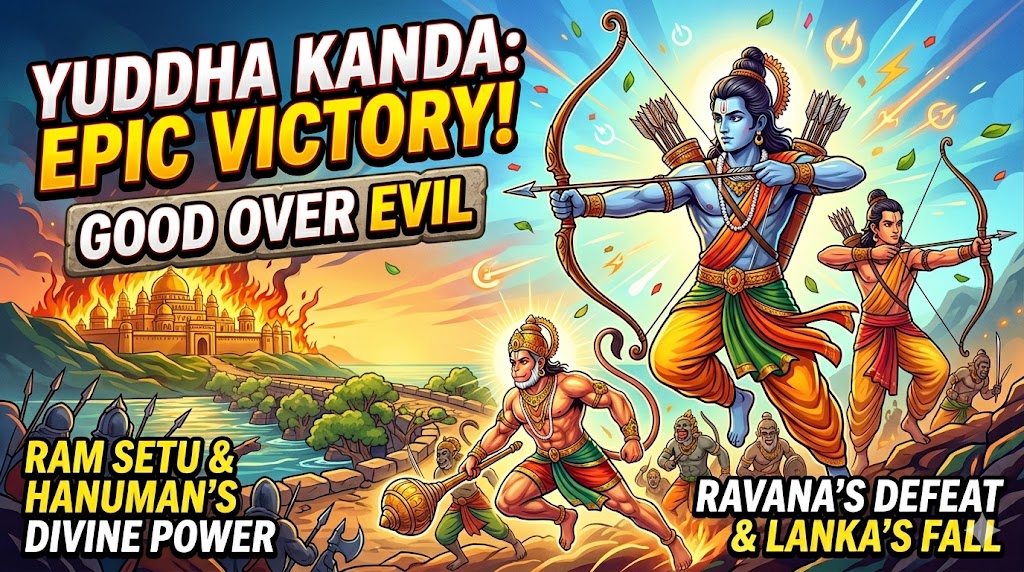
Yuddha Kanda Ramayan: Epic Victory of Good Over Evil
Dharma• April 09, 2026• Global Edition
Introduction to the Yuddha Kanda: The Pinnacle of Ramayan’s Glory
The Yuddha Kanda, also revered as Lanka Kand, stands as the sixth and most climactic book in Valmiki’s immortal Ramayan. This sacred canto unfolds the grand war between Lord Rama’s righteous forces and the tyrannical empire of Ravana, the demon king of Lanka. It is here that the epic reaches its emotional and spiritual zenith, portraying not just a physical battle but the timeless triumph of dharma over adharma, light over darkness, and good over evil.
In this profound narrative, Lord Rama, accompanied by his devoted brother Lakshmana and the mighty vanara army led by Sugriva and Hanuman Ji, crosses the ocean to rescue Sita Mata and restore cosmic order. The Yuddha Kanda beautifully illustrates how unwavering devotion, strategic wisdom, and divine intervention converge to annihilate evil. Through every arrow, every leap, and every act of courage, it reveals the serene beauty of Sanatan Dharma – where righteousness prevails not through brute force but through purity of heart and adherence to eternal principles. As we delve into its details, one cannot help but feel the romantic idealism of Rama’s love for Sita, the fraternal bond with Lakshmana, and Hanuman Ji’s selfless bhakti that fuels the victory. Lanka’s eventual destruction marks not mere conquest but the divine restoration of harmony.
Before immersing ourselves in the war’s intensity, let us briefly revisit the preceding kandas that set the stage for this magnificent climax.
Brief Overview of the Preceding Kandas: Building the Foundation of Dharma
Bala Kanda (Book of Youth): This opening canto introduces the divine birth of Lord Rama as the incarnation of Vishnu in the Ikshvaku dynasty. King Dasharatha’s yajna yields four sons – Rama, Bharata, Lakshmana, and Shatrughna. Rama’s childhood feats, including his education under Vishwamitra and the breaking of Shiva’s bow to win Sita’s hand in marriage, establish his unparalleled virtues: strength, wisdom, and compassion. It sets the tone for Rama as the ideal man (Maryada Purushottama).
Ayodhya Kanda (Book of Ayodhya): Here, the narrative shifts to palace intrigue. As Dasharatha prepares Rama’s coronation, Queen Kaikeyi, influenced by her maid Manthara, demands the two boons promised to her – Rama’s 14-year exile and Bharata’s enthronement. Rama, embodying filial duty, accepts exile without hesitation. Sita and Lakshmana insist on accompanying him, highlighting ideals of loyalty and sacrifice. Dasharatha dies heartbroken, and Bharata refuses the throne, preserving Rama’s rightful claim. This kanda underscores dharma in family and kingship.
Aranya Kanda (Book of the Forest): Life in exile unfolds in the Dandaka forest. Rama protects sages from demons like Viradha and Khara. The turning point arrives when Surpanakha, Ravana’s sister, is humiliated, prompting Ravana’s vengeful abduction of Sita using the golden deer illusion created by Mareecha. Jatayu’s heroic attempt to save Sita ends in his mortal wounding. Rama’s grief and search begin, marking the transition from peace to righteous war.
Kishkindha Kanda (Book of the Monkey Kingdom): Rama allies with Sugriva, the exiled vanara king, by slaying the tyrannical Vali. In return, Sugriva dispatches search parties for Sita. Hanuman Ji emerges as the ultimate devotee, leaping toward Lanka after Sampati’s guidance. This kanda celebrates friendship, strategy, and the vanaras’ valor, laying the groundwork for the army that will storm Lanka.
Sundara Kanda (Book of Beauty): Hanuman Ji’s solo mission shines here. He crosses the ocean, evades Lanka’s defenses, consoles Sita in Ashoka Vatika, delivers Rama’s ring, and receives her chudamani. In a display of fury and devotion, he sets Lanka ablaze before returning with Sita’s message. This kanda is a masterpiece of bhakti, courage, and hope, bridging exile to war.
With these foundations of love, loss, and loyalty firmly in place, the Yuddha Kanda erupts into action – a symphony of heroism where evil meets its destined end.
The Dawn of Yuddha Kanda: Preparations and the Call to Arms
As the Yuddha Kanda opens, Rama warmly embraces Hanuman Ji, praising his extraordinary feats in Sundara Kanda. Yet, despair lingers over crossing the vast ocean to reach Lanka. Sugriva comforts him, while Hanuman provides a vivid description of Lanka’s formidable defenses – its golden walls, moats, and Ravana’s mighty Rakshasa army. Rama, ever the strategist, selects an auspicious hour for departure.
Meanwhile, in Lanka, Ravana convenes his ministers. Boastful demons urge war, but Vibhishana – Ravana’s righteous brother – advises returning Sita to avert doom, citing omens and Rama’s invincibility. Enraged, Ravana exiles him. Vibhishana flies to Rama’s camp, seeking refuge. Rama, true to dharma, accepts him warmly, crowning him future king of Lanka. This alliance proves pivotal, offering insider knowledge that tilts the scales.
Construction of Ram Setu: Engineering Divine Will
Rama appeals to the Ocean God, who advises building a bridge. Under the guidance of Nala and Neela – vanara architects blessed by Vishwakarma – the monkey army constructs the legendary Ram Setu (Adam’s Bridge) in just five days. Rocks and trees are hurled into the sea, forming a pathway that symbolizes human (and vanara) ingenuity united with divine grace. The army marches across, encamping on Mount Suvela, overlooking Lanka. Ravana’s spies report the threat, heightening tensions.
The Ultimate Triumph: Lord Rama and Lakshmana lead the righteous charge, supported by the divine strength of Hanuman Ji, to dismantle Ravana’s tyranny and restore peace to the universe.
The Great War Unfolds: Initial Clashes and Heroic Duels
Ravana launches sorties. Fierce battles erupt between vanaras and Rakshasas. Key warriors shine: Angada, Jambavan, and Hanuman decimate demons. Dhumraksha, Vajradanshtra, Akampana, and Prahasta fall one by one. Ravana himself enters the fray but retreats after clashing with Rama.
The war intensifies with Kumbhakarna’s awakening. This colossal demon, Ravana’s brother, slumbers for months but rises to fight. Despite advising peace earlier, he honors duty and battles valiantly, only to be slain by Rama after a titanic duel. Grief grips Lanka.
Indrajit, Ravana’s son and master of illusions, proves the deadliest foe. Invisible and wielding Brahmastras, he fells Rama and Lakshmana. Hanuman Ji, on Jambavan’s advice, flies to the Himalayas, uprooting the Sanjeevani mountain to heal them with its herbs. The fragrance revives the brothers and the army instantly – a testament to Hanuman’s speed and devotion.
Indrajit later creates an illusory Sita, slaying her before the vanaras to demoralize them. Vibhishana exposes the trick. Lakshmana confronts Indrajit in a ferocious battle, ultimately killing him with divine weapons. Ravana’s fury peaks.
Hanuman Ji’s Unparalleled Contributions and the Climax
Throughout the Yuddha Kanda, Lord Hanuman Ji’s presence is divine grace personified. Beyond the Sanjeevani mission, he slays countless demons, including Trishira, and inspires the troops. His leaps, strength, and unwavering bhakti amplify Rama and Lakshmana’s efforts. While Hanuman does not deliver the final blow to Ravana – that honor belongs to Rama – his relentless support makes victory possible. Rama and Lakshmana fight with unmatched valor: Lakshmana fells Atikaya and others, while Rama’s arrows rain justice.
The epic duel between Rama and Ravana spans days. Ravana’s heads regrow, his chariot thunders. Rama invokes the Brahmastra, advised by Sage Agastya’s mantra, piercing Ravana’s heart. The demon king falls, his tyranny ending. Lanka trembles as good triumphs. Vibhishana performs Ravana’s last rites with dignity, then ascends the throne.
Sita’s Agni Pariksha and the Return of Light
Rama sends Hanuman to inform Sita of victory. Vibhishana escorts her to Rama. In a heart-wrenching moment – misunderstood by some yet rooted in dharma – Rama tests Sita’s purity publicly. She enters the pyre fearlessly. Agni Dev emerges, declaring her innocence. Rama rejoices, affirming his faith; the trial was for the world’s eyes. Gods descend: Indra grants boons, Dasharatha blesses from heaven. This sequence beautifully underscores Sanatan Dharma’s emphasis on truth, purity, and public accountability.
Lanka’s Destruction and the Eternal Message of Victory
As Rama’s forces prevail, Lanka’s palaces burn, its evil empire crumbles – not in vengeance but as cosmic justice. The city, once a symbol of Ravana’s arrogance, transforms under Vibhishana’s righteous rule. This destruction is poetic: evil self-destructs when confronted by unyielding dharma. Rama, Sita, and Lakshmana return via Pushpaka Vimana, stopping at key sites. Bharata welcomes them at Ayodhya. Rama’s coronation marks Ram Rajya – an era of peace, prosperity, and justice.
The Yuddha Kanda is more than war; it is the serene emergence of victory over evil, where Lord Rama and Lakshmana’s prowess, amplified by Hanuman Ji’s devotion, upholds Sanatan Dharma’s eternal truths. It teaches that righteousness may face trials but ultimately prevails through courage, wisdom, and bhakti. Lanka’s fall reminds us that adharma, however powerful, cannot endure against dharma’s light. In today’s world, this canto inspires millions – as seen in Ramanand Sagar’s iconic TV adaptation – to embrace duty, loyalty, and faith.
May the lessons of Yuddha Kanda illuminate our lives, reminding us that every personal “Lanka” of challenges yields to the Ram within us. Jai Shri Ram!
Frequently Asked Questions
What is the primary significance of Yuddha Kanda Ramayan: Epic Victory of Good Over Evil?
Introduction to the Yuddha Kanda: The Pinnacle of Ramayan’s GloryThe Yuddha Kanda, also revered as Lanka Kand, stands as the sixth and most climactic book in Valmiki’s immortal Ramayan. This sacred canto unfolds the grand war between Lord Rama’s righteous forces and the tyrannical empire of Ravana, the demon king of Lanka.
How does this development impact Dharma?
It is here that the epic reaches its emotional and spiritual zenith, portraying not just a physical battle but the timeless triumph of dharma over adharma, light over darkness, and good over evil. In this profound narrative, Lord Rama, accompanied by his devoted brother Lakshmana and the mighty vanara army led by Sugriva and Hanuman Ji, crosses the ocean to rescue Sita Mata and restore cosmic order. The Yuddha Kanda beautifully illustrates how unwavering devotion, strategic wisdom, and divine intervention converge to annihilate evil.
What are the key future projections to monitor?
Through every arrow, every leap, and every act of courage, it reveals the serene beauty of Sanatan Dharma – where righteousness prevails not through brute force but through purity of heart and adherence to eternal principles.