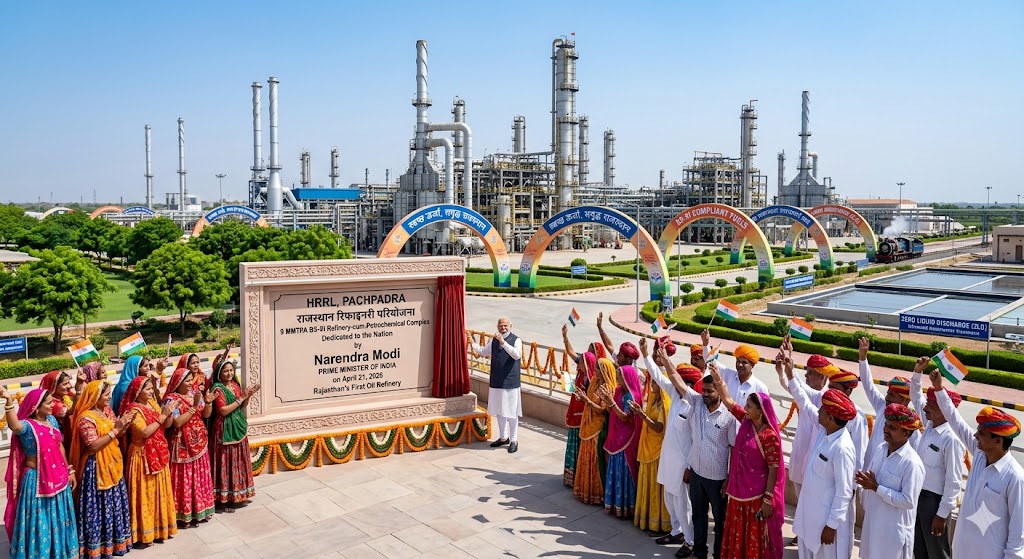
On April 21, 2026, Prime Minister Narendra Modi is scheduled to inaugurate the Pachpadra Refinery in Rajasthan’s Barmer district (now part of Balotra district). This landmark event will dedicate to the nation one of India’s most advanced refinery-cum-petrochemical complexes. The Pachpadra refinery inauguration represents far more than a ceremonial occasion—it symbolizes Rajasthan’s entry into the league of major hydrocarbon hubs and fulfills a long-standing dream of energy self-reliance for the state and northern India.
The Rajasthan refinery project, developed by HPCL Rajasthan Refinery Limited (HRRL), is a joint venture between Hindustan Petroleum Corporation Limited (74% stake) and the Government of Rajasthan (26% stake). With a revised project cost of ₹79,459 crore, the facility boasts a 9 million metric tonnes per annum (MMTPA) crude refining capacity alongside a 2 MMTPA petrochemical complex. As Rajasthan’s first oil refinery, the Pachpadra refinery will process both local Barmer crude and imported Arab Mix, delivering BS-VI compliant fuels and high-value petrochemicals.
This article delves into every aspect of the Pachpadra refinery: its making cost, technical specifications, strategic location choice, economic impact, employment potential, environmental features, and the transformative benefits it will bring to Rajasthan. Readers will also understand why Pachpadra in Barmer was selected and how this project elevates the state’s industrial landscape.
Historical Background of the Rajasthan Refinery Project
The journey of the Pachpadra refinery began over a decade ago. The foundation stone was first laid on September 22, 2013, by Sonia Gandhi. However, progress remained slow until Prime Minister Narendra Modi relaunched the project on January 16, 2018, at Pachpadra, infusing fresh momentum and vision.
Initial estimates pegged the cost at around ₹37,230–43,129 crore. Over the years, as scope expanded to include advanced petrochemical units and stricter environmental norms, the investment rose to ₹72,937 crore by 2023 and further to the current ₹79,459 crore following detailed engineering reviews and inflation adjustments. Despite cost escalations, the project’s internal rate of return (IRR) improved significantly—from an initial 6.32% to 12.2%—reducing the financial burden on the Rajasthan government by approximately ₹40,000 crore.
Construction gained pace after 2018, with major milestones achieved by Tata Projects, L&T Hydrocarbon Engineering, Technip Energies, and Engineers India Limited (EIL). Trial runs for crude processing in the first phase commenced in January 2026, setting the stage for the April 21 inauguration by PM Modi. This Rajasthan refinery project has consistently been highlighted in state and central budgets as a flagship initiative for regional development.
Project Specifications and Technical Excellence
The Pachpadra refinery stands out as one of India’s most modern BS-VI standard facilities. Spread across 4,400.4 acres approximately 5 km from Pachpadra village, the complex features 29 state-of-the-art process units designed for efficiency, safety, and zero liquid discharge (ZLD).
Key Technical Highlights:
Crude Distillation Unit (CDU):9 MMTP
Vacuum Distillation Unit (VDU): 4.8 MMTPA
Naphtha Hydrotreater 1.8 MMTPA
Diesel Hydrotreater (DHDT): 4.1 MMTPA
Delayed Coker Unit (DCU): 2.4 MMTPA
Vacuum Gas Oil Hydrotreater (VGO-HDT): 3.5 MMTP
fluidised Catalytic Cracking Unit (PFCC): 2.9 MMTPA
Additional units include naphtha isomerisation, dual-feed cracker, ethylene recovery, two polyethylene units, and two polypropylene units (using Lummus Novolen technology).
The refinery will process 1.5 MMTPA of indigenous Rajasthan crude (primarily from the Mangala field) and 7.5 MMTPA of imported Arab Mix crude in the initial eight years, transitioning fully to imported crude thereafter. Products include BS-VI grade petrol and high-speed diesel, plus petrochemicals such as polypropylene, butadiene, linear low-density polyethylene (LLDPE), high-density polyethylene (HDPE), benzene, and toluene.
A dedicated captive power plant (four 33 MW gas turbine generators) meets the 211 MW power requirement. Supporting infrastructure includes a 210-km raw water pipeline from Nachna Reservoir, crude and product storage tanks, and pipelines for crude and finished products. The entire setup ensures high yield, lower emissions, and compliance with the world’s strictest fuel standards.
Why Pachpadra in Rajasthan Was Chosen
The selection of Pachpadra, Barmer district, was no coincidence. Barmer has been a hydrocarbon hotspot since the 2004 discovery of the Mangala oil field by Cairn Energy. Locating the refinery here allows seamless integration with local crude production, cutting transportation costs and logistics challenges.
Pachpadra lies strategically along the Amritsar-Jamnagar Expressway, connecting it to major refineries at Jamnagar and Bathinda. This positioning creates an emerging energy corridor ideal for serving the high-demand markets of northern, western, and central India. The desert terrain offered large, contiguous land parcels (over 4,800 acres) with minimal displacement issues, while government incentives and Rajasthan’s industrial policy provided additional support.
By choosing Pachpadra, the project also catalyzes development in the backward Barmer-Jaisalmer region, transforming it into an industrial hub. A 100 sq km petrochemical processing zone is being developed nearby, attracting downstream units in plastics, packaging, textiles, and automotive components. Railway connectivity is being enhanced with a new 12-km line from Balotra to the refinery site, and freight traffic is expected to surge. In essence, Pachpadra was chosen for its resource proximity, logistical advantage, and potential to drive balanced regional growth—making the Rajasthan refinery project a model of strategic planning.
PM Modi to inaugurate BS -6 refinery in Rajasthan's pachpadra on 21 April
Financial Aspects: Making Cost and ROI Improvement
The Pachpadra refinery’s total investment of ₹79,459 crore makes it one of the largest single-location industrial projects in Rajasthan’s history. Funding follows a 2:1 debt-equity ratio, with HPCL and the state government contributing equity while a consortium of lenders (led by State Bank of India) provides debt financing. REC Limited alone extended ₹4,785 crore as part of a larger ₹48,625 crore consortium loan.
The cost escalation reflected global material price hikes, enhanced environmental safeguards, and addition of advanced petrochemical units. Yet, value engineering and improved crude sourcing boosted project viability. The higher IRR not only enhances returns for stakeholders but also significantly lowers the long-term subsidy or guarantee burden on the Rajasthan exchequer.
This financial prudence ensures the Rajasthan refinery project delivers sustainable ROI while generating substantial tax revenues through VAT on products, excise duties, and royalties on crude.
Environmental and Sustainability Features
The Pachpadra refinery is engineered as a zero liquid effluent discharge facility—the country’s most modern in the BS-VI category. Advanced wastewater treatment, solar evaporation ponds, and stringent emission controls minimize environmental footprint. By producing BS-VI fuels, it directly contributes to cleaner air in northern India, reducing vehicular pollution.
The project incorporates energy-efficient technologies across all process units, aligning with India’s net-zero ambitions. Community initiatives during construction included skill development programs and infrastructure support, ensuring sustainable development alongside industrial growth.
Economic Impact and Benefits to Rajasthan
The Rajasthan refinery project will be a game-changer for the state’s economy. It will anchor a cluster of downstream industries, spurring investments in plastics, polymers, and specialty chemicals. Annual production of 9 million tonnes of refined products and 2 million tonnes of petrochemicals will meet surging domestic demand, reduce import dependence, and save foreign exchange.
State revenues will rise through taxes, duties, and increased economic activity. The Barmer region will witness infrastructure upgrades—roads, railways, power, and water—benefiting surrounding villages. Overall, the Pachpadra refinery is projected to add thousands of crores to Rajasthan’s GSDP annually and position the state as a petrochemical powerhouse.
Employment Generation and Social Development
Direct employment during operations is estimated at over 1,500 permanent jobs, with construction-phase opportunities exceeding 30,000–40,000. Indirect jobs in ancillary units, logistics, and services could reach 60,000, according to project estimates. Priority is being given to local youth through skill training in welding, instrumentation, safety, and refinery operations.
Beyond jobs, the project includes development of schools, hospitals, and community facilities. Rajasthan State Industrial Development and Investment Corporation (RIICO) is investing heavily in the Balotra refinery ecosystem, promising holistic socio-economic upliftment in one of Rajasthan’s most underdeveloped districts.
Prime Minister Modi’s Vision and Rajasthan Visits
Prime Minister Narendra Modi has been the driving force behind the Pachpadra refinery. From relaunching the project in 2018 to multiple Rajasthan visits—including a February 28, 2026, event in Ajmer where he inaugurated projects worth over ₹16,680 crore—his personal oversight has accelerated progress. The April 21, 2026, inauguration in Pachpadra will be his second visit to the state in two months, underscoring the national priority accorded to this transformative project.
Upcoming Inauguration and Future Outlook
As Rajasthan prepares for the April 21, 2026, Pachpadra refinery inauguration by PM Modi, anticipation is high. Commercial production is expected to ramp up rapidly post-dedication, with full capacity utilization targeted within the following year. The event will also highlight allied developments like the new railway siding and petrochemical zone.
Looking ahead, the Pachpadra refinery will strengthen India’s refining capacity, support Atmanirbhar Bharat in energy, and unlock Rajasthan’s industrial potential. It stands as a testament to visionary planning, public-private partnership, and sustainable development.
Conclusion
The Pachpadra refinery is more than an industrial facility—it is a beacon of progress for Rajasthan. From its ₹79,459 crore investment and cutting-edge BS-VI technology to its role in generating employment, revenue, and cleaner fuels, this Rajasthan refinery project will reshape the state’s economic destiny. As Prime Minister Narendra Modi inaugurates the facility on April 21, 2026, Rajasthan steps confidently into a new era of energy leadership and inclusive growth.
The Barmer refinery news has already ignited optimism across the state. For investors, policymakers, and citizens alike, the Pachpadra refinery inauguration heralds opportunities that will benefit generations to come.
Frequently Asked Questions
What is the primary significance of PM Modi to Inaugurate Pachpadra Refinery on April 21?
A Historic Milestone for Rajasthan’s Energy FutureOn April 21, 2026, Prime Minister Narendra Modi is scheduled to inaugurate the Pachpadra Refinery in Rajasthan’s Barmer district (now part of Balotra district). This landmark event will dedicate to the nation one of India’s most advanced refinery-cum-petrochemical complexes.
How does this development impact News?
The Pachpadra refinery inauguration represents far more than a ceremonial occasion—it symbolizes Rajasthan’s entry into the league of major hydrocarbon hubs and fulfills a long-standing dream of energy self-reliance for the state and northern India.The Rajasthan refinery project, developed by HPCL Rajasthan Refinery Limited (HRRL), is a joint venture between Hindustan Petroleum Corporation Limited (74% stake) and the Government of Rajasthan (26% stake). With a revised project cost of ₹79,459 crore, the facility boasts a 9 million metric tonnes per annum (MMTPA) crude refining capacity alongside a 2 MMTPA petrochemical complex.
What are the key future projections to monitor?
As Rajasthan’s first oil refinery, the Pachpadra refinery will process both local Barmer crude and imported Arab Mix, delivering BS-VI compliant fuels and high-value petrochemicals.This article delves into every aspect of the Pachpadra refinery: its making cost, technical specifications, strategic location choice, economic impact, employment potential, environmental features, and the transformative benefits it will bring to Rajasthan.