Donald Trump Biography: From Birth to 2026 Presidency
Current Affairs• April 06, 2026• Global Edition
Donald Trump stands as one of the most polarizing and consequential figures in modern American history. Born into a New York real estate family in 1946, he built a global brand through bold deals, television fame, and unfiltered public persona before entering politics as a complete outsider. Elected the 45th President in 2016, he served from 2017 to 2021, then returned as the 47th President in 2025 after winning the 2024 election—only the second U.S. leader to serve non-consecutive terms after Grover Cleveland.
This Donald Trump biography traces his journey from birth through business triumphs and setbacks, his disruptive entry into politics, two presidencies marked by economic reforms, immigration enforcement, and America First diplomacy, right up to key developments in his second term as of April 2026. It examines his administrative policies, relations with superpowers, behavior in office, and how his unique leadership style reshaped the Republican Party and global affairs. Through highs like record-low unemployment and historic Middle East accords, and controversies including impeachments and legal battles, Trump's story reflects resilience, deal-making instincts, and a commitment to putting American interests first.
Early Life and Education: Foundations in Queens
Donald John Trump was born on June 14, 1946, in the Jamaica Estates neighborhood of Queens, New York—the fourth of five children to Frederick Christ Trump Sr. and Mary Anne MacLeod Trump. His father, a self-made real estate developer of German descent, built a successful empire of middle-income rental housing in Queens and Brooklyn. His mother, a Scottish immigrant who arrived in the U.S. in 1930, worked as a homemaker while instilling strong values in the family.
Growing up in a 23-room mansion, young Donald witnessed his father's work ethic firsthand. Fred Trump expected all his sons to contribute, and Donald, along with brothers Fred Jr. and Robert, helped on construction sites from an early age. The family emphasized discipline; at 13, after some youthful mischief, Donald's parents enrolled him at the New York Military Academy. There, he thrived in a structured environment, rising to become a cadet captain and excelling in sports like baseball and football.
After high school, Trump attended Fordham University in the Bronx for two years before transferring to the University of Pennsylvania's Wharton School of Finance and Commerce. He graduated in 1968 with a bachelor's degree in economics. During the Vietnam War era, he received five draft deferments—four for education and one for bone spurs—avoiding military service. This period shaped his pragmatic, results-driven outlook, influenced heavily by his father's no-nonsense approach to business and life.
Family tragedies left marks too. Elder brother Fred Jr.'s struggle with alcoholism and death in 1981 reinforced Trump's abstinence from alcohol and cigarettes. These early experiences forged a competitive, self-reliant character that would define his later pursuits.
Building the Trump Organization: Business Empire and Branding
Upon graduation, Donald Trump joined his father's company full-time. In 1971, he took the helm, renaming it the Trump Organization. While Fred focused on outer-borough rentals, Donald set his sights on Manhattan's skyline. He negotiated a deal with the city for the Commodore Hotel, transforming it into the Grand Hyatt—his first major solo success.
The 1980s brought expansion: Trump Tower on Fifth Avenue opened in 1983 as a symbol of luxury. He ventured into casinos in Atlantic City (Trump Taj Mahal, Trump Plaza), hotels, golf courses, and airlines (Trump Shuttle). Branding became key—he licensed his name to everything from steaks to ties, turning "Trump" into a global symbol of success.
Challenges arose too. The early 1990s recession hit hard, leading to multiple corporate bankruptcies for his casinos. Yet Trump rebounded through savvy negotiations with banks and by pivoting to reality television. In 2004, The Apprentice premiered on NBC, with Trump as the no-nonsense boss delivering his signature "You're fired!" The show ran for 14 seasons, boosting his celebrity status and introducing him to millions of viewers as a decisive leader.
By the 2010s, the Trump Organization spanned real estate, entertainment, and licensing deals worldwide. His 1987 book, The Art of the Deal, co-authored with Tony Schwartz, became a bestseller, encapsulating his philosophy: think big, use leverage, and never quit. This business phase honed his negotiating skills, media savvy, and outsider perspective on government bureaucracy—traits he later applied to politics.
Entry into Politics: From Celebrity to Candidate
Trump flirted with politics for decades, switching parties multiple times and considering runs in the 1980s and 2000s. His public profile grew through tabloid headlines, beauty pageants (Miss Universe ownership), and outspoken TV appearances. In 2015, he announced his Republican presidential bid from Trump Tower, descending the escalator with the pledge to "Make America Great Again."
His campaign defied norms: blunt rhetoric on immigration, trade, and "draining the swamp" resonated with voters frustrated by globalization and Washington insiders. Despite controversies, he secured the nomination after strong primary performances. On November 8, 2016, Trump defeated Hillary Clinton in the Electoral College (304-227), though he lost the popular vote. His victory stunned pollsters and marked a populist shift in American politics.
First Presidency (2017-2021): Policies, Achievements, and Challenges
Inaugurated as the 45th President on January 20, 2017, Trump moved swiftly. Key administrative policies included the Tax Cuts and Jobs Act of 2017, slashing corporate rates and boosting economic growth pre-COVID. Deregulation rolled back environmental rules, spurring energy independence. Immigration enforcement built miles of border wall, reduced illegal crossings, and introduced travel restrictions from certain countries.
Diplomacy followed an "America First" doctrine. He brokered the Abraham Accords, normalizing relations between Israel and several Arab nations. A trade war with China imposed tariffs to address imbalances, while renegotiated deals like USMCA replaced NAFTA. Relations with Russia remained complex amid investigations, but he pressured NATO allies to increase defense spending. With North Korea's Kim Jong-un, he held historic summits. Withdrawal from the Paris Climate Agreement and Iran nuclear deal signaled skepticism toward multilateral pacts.
The COVID-19 pandemic dominated 2020. Trump launched Operation Warp Speed, accelerating vaccine development. Yet his downplaying of the virus and public disputes with health officials drew criticism. Economically, pre-pandemic unemployment hit historic lows.
Two impeachments followed: the first in 2019 over Ukraine aid and Biden family inquiries (acquitted by Senate); the second in 2021 over January 6 Capitol events after his election loss to Joe Biden (also acquitted). He left office on January 20, 2021, with a 34% approval rating but a loyal base.
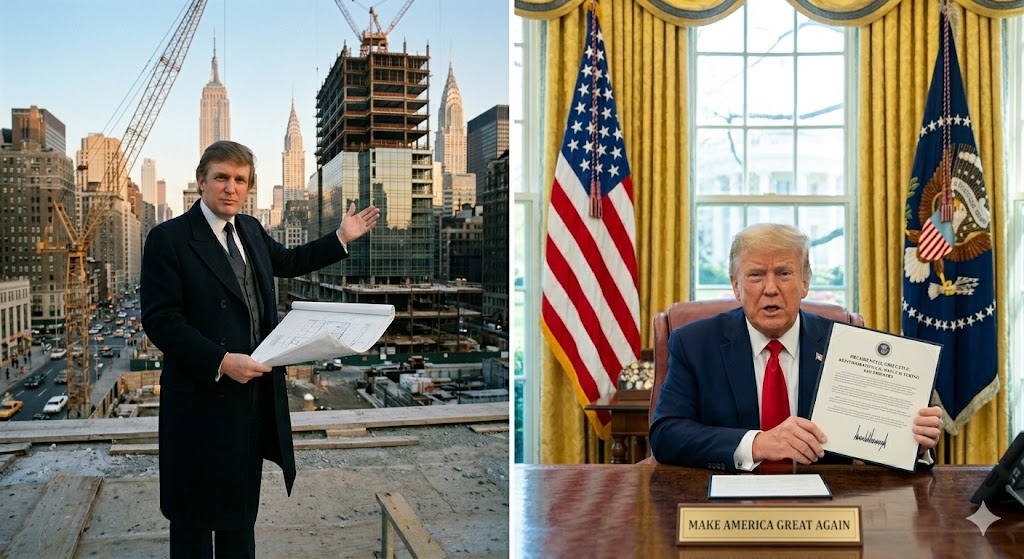
Donald Trump stands in Manhattan during the late 1970s, transitioning his focus from outer-borough residential real estate to major commercial developments like the Grand Hyatt, which marked his solo entry into the Manhattan market and President Donald Trump delivers an address from the Oval Office in early 2026, outlining his administration's "America First" policies regarding energy independence and industrial revitalization during his second term
Post-Presidency, Legal Battles, and 2024 Return
Out of office, Trump faced indictments in four cases—two federal, two state—covering classified documents, election interference, hush money, and business fraud. A 2024 New York felony conviction on 34 counts made history, yet he received no penalty after his reelection. Civil rulings included liability in the E. Jean Carroll case.
He announced a 2024 run in 2022, survived an assassination attempt in July 2024, and dominated primaries. Choosing J.D. Vance as running mate, Trump defeated Vice President Kamala Harris on November 5, 2024, securing a second term. Inaugurated January 20, 2025, he became the 47th President.
As of April 2026, Trump's second term emphasizes rapid executive action—over 250 executive orders by early April. Administrative policies focus on border security (sharp drops in illegal immigration), energy dominance, and deregulation for economic growth. Tariffs target China, Canada, and Mexico to protect U.S. manufacturing.
Diplomacy remains transactional and results-oriented. He has ended eight conflicts, including a Gaza ceasefire with hostage releases, plus deals between Cambodia-Thailand, Kosovo-Serbia, and others. Military strikes degraded Iran's nuclear program (Operation Epic Fury/Midnight Hammer) and targeted proxies. In the Western Hemisphere, U.S. forces captured Venezuelan leader Nicolás Maduro amid drug trafficking concerns, asserting a "Trump Corollary" to the Monroe Doctrine.
Relations with superpowers show continuity with change: pressure on China via trade and Indo-Pacific alliances; outreach to Russia on Ukraine (offering concessions, noting shared responsibility, though war persists); and demands for NATO burden-sharing (5% GDP target). Europe faces tariffs unless allies step up. With Israel, coordination remains strong; Middle East stability improved via weakened Iran.
Behavior in office mirrors his first term: bold rallies, direct social media engagement, and deal-maker pragmatism. Current war situations reflect his peace-through-strength approach—de-escalation where possible, decisive force against threats like Houthis or cartels. Economy shows job gains and reduced inflation, though global tensions linger.
Leadership Style, Behavior, and Public Persona
Trump's psychological nature and behavior stem from his ambitious, dominant, and outgoing personality. Publicly, he exhibits high energy, resilience under pressure, and a gift for connecting with crowds through straightforward language. Supporters see a fighter who challenges elites; critics note impulsiveness and polarization.
In administration, he favors loyalty, quick decisions, and disruption of norms—traits evident in foreign policy leverage and domestic reforms. Statements often blend optimism with blunt warnings, as in "America First" framing. This style mobilized voters but fueled division. Analyses describe him as charismatic yet nondeliberative, thriving on attention while delivering tangible results.
Legacy and Impact as of 2026
From Queens to the White House twice, Donald Trump's biography embodies American reinvention. His political career transformed the GOP into a populist force, influenced Supreme Court appointments, and prioritized U.S. sovereignty in trade and borders. Diplomacy shifted from globalism toward bilateral deals, yielding Middle East breakthroughs and allied spending increases, while second-term actions addressed threats in Iran, Venezuela, and beyond.
Challenges persist—legal aftermath, partisan divides, ongoing Ukraine tensions—but his return underscores enduring appeal. As the 47th President navigates 2026, Trump's story continues to shape America's place in the world.
Frequently Asked Questions
What is the primary significance of Donald Trump Biography: From Birth to 2026 Presidency?
Donald Trump stands as one of the most polarizing and consequential figures in modern American history. Born into a New York real estate family in 1946, he built a global brand through bold deals, television fame, and unfiltered public persona before entering politics as a complete outsider.
How does this development impact Current Affairs?
Elected the 45th President in 2016, he served from 2017 to 2021, then returned as the 47th President in 2025 after winning the 2024 election—only the second U.S. leader to serve non-consecutive terms after Grover Cleveland. This Donald Trump biography traces his journey from birth through business triumphs and setbacks, his disruptive entry into politics, two presidencies marked by economic reforms, immigration enforcement, and America First diplomacy, right up to key developments in his second term as of April 2026.
What are the key future projections to monitor?
It examines his administrative policies, relations with superpowers, behavior in office, and how his unique leadership style reshaped the Republican Party and global affairs.