"Khatu Shyam Ji Temple: History, Devotion and Mela"

Khatu Shyam Ji Temple: History, Mahima & Mela
In the heart of Rajasthan’s Shekhawati region lies a sacred shrine that draws millions every year with a quiet, unwavering pull. Khatu Shyam Ji, lovingly called Shyam Baba or Hare ka Sahara, stands as more than just a temple — he is the living promise of Lord Krishna in Kali Yuga. Devotees from every corner of India and abroad arrive not merely for darshan but with hearts heavy with troubles, leaving lighter, believing that whatever unfolds in their lives happens by Khatu Shyam Ji’s grace. In 2026, the temple’s popularity has reached unprecedented heights, with weekly footfall crossing two lakh and the annual Phalgun Mela witnessing over fifty lakh visitors. Yet behind this modern surge lies an ancient tale of sacrifice, divine blessing, and eternal devotion that stretches from the Mahabharata to the present day.
This article delves deep into the complete history of Khatu Shyam Ji — who he truly was, how Lord Narayan blessed him, the establishment of his magnificent Khatu Shyam Mandir, the sacred Shyam Kund, the miraculous Surajgarh Nishan story, famous bhakt incidents, and every detail that makes this pilgrimage site one of India’s most vibrant spiritual destinations today.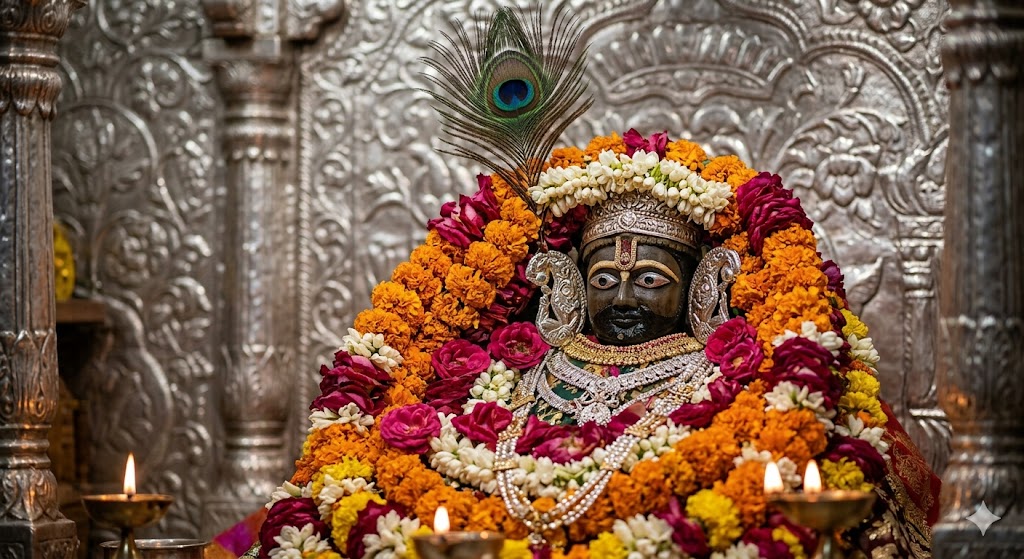
The serene and radiant idol of Khatu Shyam Ji within the inner sanctum of the Khatu Shyam Mandir, Rajasthan, adorned with traditional fresh flower garlands and a peacock feather.
Who Was Khatu Shyam Ji? The Mahabharata Connection
Khatu Shyam Ji is none other than Barbarika, the mighty grandson of Bhima and son of Ghatotkacha. Born to Ghatotkacha and Maurvi (daughter of the demon king Mura), Barbarika displayed superhuman strength and devotion from childhood. His father named him Barbarika because his hair resembled that of the Barbara tribe. Trained in warfare by his mother and further empowered by the goddesses he worshipped on Krishna’s advice, Barbarika received three infallible arrows — "Teen Baan" — from Lord Shiva himself.
The first arrow would mark everything he wished to destroy, the second everything he wished to protect, and the third would execute the task with unerring precision. Armed with these divine weapons and an unshakeable vow to always fight for the weaker side, Barbarika possessed the power to end any battle in minutes. Before the great Kurukshetra war, he declared he could finish the entire Mahabharata conflict in just one minute.
Lord Krishna, ever the protector of dharma, foresaw the chaos. Disguised as a Brahmin, he tested Barbarika by asking him to pierce every leaf of a Peepal tree. Krishna secretly hid one leaf beneath his foot, yet the arrow lifted the foot gently and struck the hidden leaf. Impressed yet concerned, Krishna revealed his true form and explained that Barbarika’s participation would violate the natural balance of the war. He requested Barbarika’s head as guru dakshina — the ultimate charity.
Without hesitation, the young warrior agreed. He only asked that his head be placed on a hill so he could witness the entire war. Krishna granted the boon. After the war ended, Barbarika’s head identified Krishna’s Sudarshan Chakra as the true hero. Pleased beyond measure by this supreme sacrifice and devotion, Lord Krishna placed the head in the Rupawati River. There the story of Khatu Shyam Ji truly begins.
Lord Narayan’s Divine Blessing: “You Will Be Famous by My Name Shyam”
The blessing that transformed Barbarika into Khatu Shyam Ji remains one of the most poignant moments in Hindu lore. After witnessing the war and proving his selflessness, Barbarika received immortality through nectar sprinkled by Goddess Chandika. Lord Krishna then declared: “In Kali Yuga, you shall be worshipped as Shyam — my own name. Whoever remembers you with a pure heart will receive my blessings. You will be the support of the defeated, the downtrodden, and those who have lost all hope. Your name will bring victory to the weak and fulfillment to every sincere prayer.”
This promise is why devotees affectionately call him "Hare ka Sahara" — the refuge of the loser. It is believed that Khatu Shyam Ji’s presence ensures that no sincere seeker leaves empty-handed. In the present era of 2026, countless devotees testify that their thoughts, decisions, and even sudden turns of fortune feel guided by Shyam Baba. They arrive with problems that seem insurmountable and depart convinced that “whatever is happening is because of Khatu Shyam Ji.”
History Behind the Establishment of Khatu Shyam Mandir
Centuries after the Mahabharata, in the early Kali Yuga, Barbarika’s sacred head resurfaced in the village of Khatu. Legend says a cow spontaneously began releasing milk at a particular spot. Villagers dug and discovered the divine head. A local Brahmin, guided by prayer, learned the full story and informed the ruler.
In 1027 AD, Raja Roop Singh Chauhan of the Chauhan dynasty received a divine dream instructing him to build a temple at the site. He unearthed the idol, installed it with great ceremony on Phalgun Shukla Ekadashi (the 11th day of the bright fortnight of Phalgun), and thus established the original Khatu Shyam Mandir. The Chauhan Rajputs had long enjoyed Lord Krishna’s blessings, and this act cemented their connection with Khatu Shyam Ji.
The temple underwent major renovation in 1720 AD under Diwan Abhaisingh, who gave it the grand form visible today. Built with pristine white Makrana marble, the architecture showcases classic Rajasthani elegance — silver-plated doors, intricately carved pillars, and a sanctum sanctorum adorned with silver sheets. The Jagmohan (prayer hall) features painted scenes from the Mahabharata and Krishna’s leelas. Adjacent to the main temple complex lies Shyam Bagichi, a serene flower garden, and the most sacred site of all — Shyam Kund.
Shyam Kund: The Holy Pond of Discovery
Shyam Kund is the exact spot where the divine head was discovered. Devotees consider a dip in its waters essential before entering the main sanctum. The pond’s calm waters are believed to carry the purifying energy of Khatu Shyam Ji himself. Many bhakts report profound peace and clarity after bathing here, reinforcing the belief that Khatu Shyam Ji cleanses not just the body but the soul’s deepest karmic burdens.
The Grand Phalgun Mela: February-March Festival of Lakhs
Every year during the Hindu month of Phalgun (usually February or March), the town of Khatu transforms into a sea of saffron and devotion. The famous Lakhi Mela or Phalgun Mela commemorates the day Barbarika offered his head. In 2026, the mela is expected to run with peak celebrations around Phalgun Shukla Ekadashi, drawing over fifty lakh pilgrims. The atmosphere resonates with continuous bhajans, aartis, and the rhythmic chants of “Jai Shree Shyam.”
The highlight is the Nishaan Yatra — a vibrant procession where devotees carry triangular saffron flags on foot from Reengus (17 km away), singing and dancing the entire way. Prasad of kheer and churma is distributed on Dwadashi. The mela is not merely a fair; it is a living expression of collective faith where rich and poor, young and old, stand shoulder to shoulder seeking Khatu Shyam Ji’s blessings.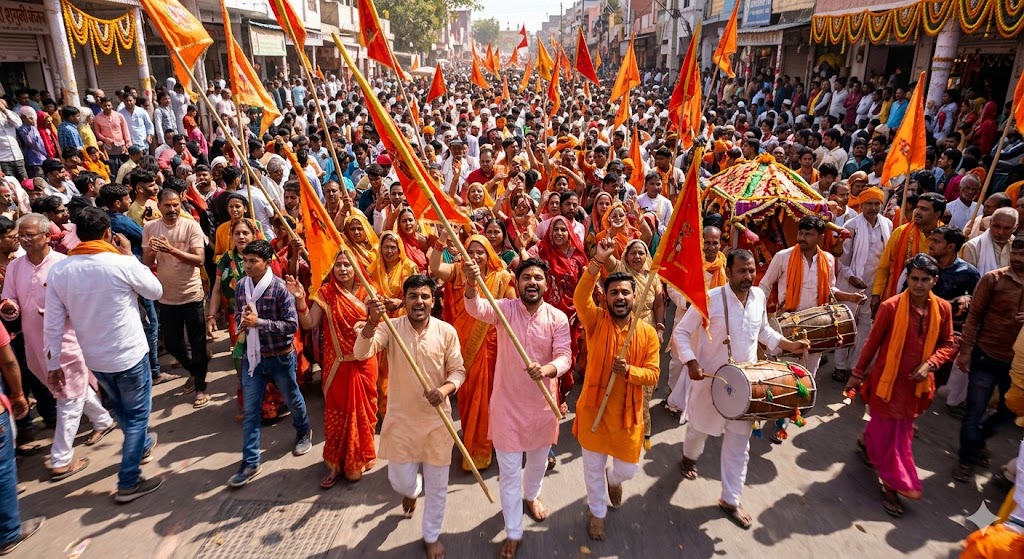
Devotees participating in the Nishan Yatra during the Phalgun Mela. They carry triangular saffron flags (Nishans) on foot from Reengus to Khatu town, filling the atmosphere with chants of "Jai Shree Shyam."
Why Khatu Shyam Ji Became So Popular and Famous in 2026
In 2026, Khatu Shyam Ji’s fame has exploded beyond traditional boundaries. Once a regional pilgrimage site, the temple now welcomes over two lakh visitors weekly. Annual donations have crossed Rs 250 crore, and the Rajasthan government has invested over Rs 350 crore in infrastructure — including a new temple corridor. Young Indians, especially, have embraced Shyam Baba as their personal deity. Social media is flooded with Khatu Shyam songs, shorts, status updates, and live aarti streams. Bollywood celebrities, politicians, and common citizens alike flock here.
The reason is simple yet profound: in an age of uncertainty, people crave a deity who promises to stand by the underdog. Khatu Shyam Ji’s message — “I am with you when everyone else has left” — resonates powerfully. Devotees believe their thoughts and actions are divinely guided the moment they surrender at his feet. This emotional connection, amplified by digital bhajans and easy travel, has made Khatu Shyam Mandir one of North India’s fastest-growing spiritual hubs.
Miracles, Famous Bhakt Stories & Divine Incidents
The mahima of Khatu Shyam Ji is best understood through the countless stories shared by bhakts across generations. One of the oldest and most revered is the Surajgarh Nishan miracle.
During British rule, officers locked the temple doors to stop the annual flag hoisting and mela. Devotee Sanvlaram arrived from Surajgarh carrying the sacred Nishan (flag) adorned with a blue horse. His companion Mangalaram, following Baba’s inner voice, touched the heavy British lock with a single peacock feather — the same feather associated with Lord Krishna. The lock opened instantly. Since that miraculous day over 325 years ago, the Surajgarh Nishan has been the first flag hoisted atop the temple every Phalgun Mela. A 152-km padyatra still carries it with royal honor, symbolizing unbroken devotion and resistance against all odds.
Other timeless bhakt stories include:
- A childless couple who received darshan in a dream and were blessed with twins after sincere prayer at Shyam Kund.
- A businessman on the verge of bankruptcy who offered a silver horse and saw his fortunes reverse overnight.
- Soldiers and athletes who credit Khatu Shyam Ji for victories after vowing to walk barefoot during the Nishaan Yatra.
These incidents, passed orally and now shared in viral Khatu Shyam bhajans and shorts, reinforce the belief that Shyam Baba never fails those who come with a pure heart.
Different Names and Forms of Khatu Shyam Ji
Khatu Shyam Ji is known by many loving names: Shyam Baba, Khatushyamji, Baliyadev (in Gujarat, especially for newborn blessings), and Belarsen. Each name highlights a facet — protector, wish-fulfiller, and eternal friend of Krishna. His idol depicts a youthful, radiant form with a peacock feather, dark complexion, and standing posture, embodying both warrior strength and divine compassion.
Devotional Practices: Aarti, Bhajan, Chalisa & Mantras
Daily aarti at Khatu Shyam Mandir is a mesmerizing experience. The most popular is Shri Khatu Shyam Ji Ki Aarti, sung with fervor at morning and evening timings. Devotees also recite the Khatu Shyam Chalisa, Shyam Stuti , and Shyam Pacchisi (a 17th-century 25-couplet poem by Durga Das Mathur). Thousands of new Khatu Shyam songs and bhajans flood platforms every year, keeping the devotion alive in modern hearts. The mantra “Jai Shree Shyam” echoes continuously, creating an atmosphere where even first-time visitors feel instantly connected.
Visiting Khatu Shyam Mandir Today: Practical Insights
The temple opens at 5:30 AM and closes around 9 PM (with slight variations in winter). Special arrangements are made during the Phalgun Mela and major festivals like Janmashtami and Shyam Janmotsav. A holy dip at Shyam Kund followed by darshan of the main idol and offering at the silver horse shrine completes the pilgrimage. Whether you come for a quick darshan or stay for the mela, the energy of Khatu Shyam Ji ensures you carry his blessings home.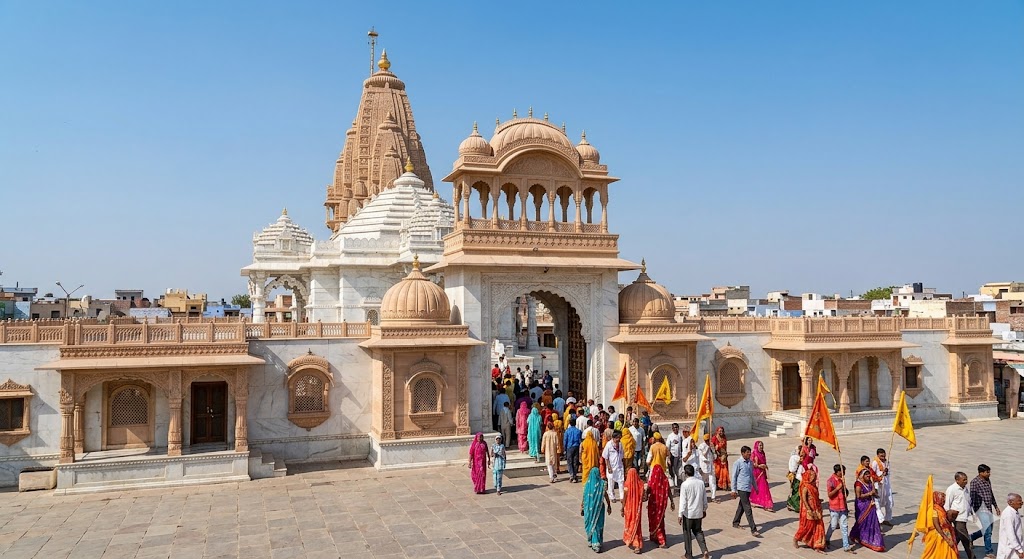
The magnificent facade of the Khatu Shyam Mandir, built with white Makrana marble. The architecture displays classic Rajasthani elegance, attracting millions of devotees annually to Sikar district.
Conclusion: The Eternal Refuge in Kali Yuga
From the battlefield of Kurukshetra to the bustling temple complex in Rajasthan in 2026, the journey of Khatu Shyam Ji is a testament to the power of pure devotion and divine love. Lord Krishna’s blessing has made him the king of Kali Yuga — a deity who stands firmly with the defeated, fulfills sincere wishes, and transforms lives in ways both ordinary and miraculous.
As millions continue to flock to Khatu Shyam Mandir, chanting “Hare ka Sahara Khatu Shyam Hamara,” one truth remains constant: whoever surrenders at his feet finds not just solutions but a lifelong divine companion. In the words of countless bhakts, “Jisne Shyam ko paaya, usne sab kuch paaya.”
Jai Shree Shyam!