"Strait of Hormuz: Global Lifeline in 2026 Crisis"
International Affairs• April 05, 2026• Global Edition
The Strait of Hormuz stands as one of the most vital waterways on the planet, a narrow chokepoint that connects the Persian Gulf to the Gulf of Oman and, ultimately, the Arabian Sea. For centuries, this strategic passage has shaped global trade, energy flows, and geopolitical rivalries. Today, in April 2026, the Strait of Hormuz finds itself at the heart of a dangerous escalation in the ongoing US-Israel war with Iran. With Iran selectively blocking most traffic while allowing safe passage for friendly nations like India and Iraq, and US President Donald Trump issuing fresh ultimatums threatening “all hell” if the waterway does not reopen, the world watches anxiously.
This article explores the history of the Strait of Hormuz, its unmatched importance to the Middle East, Asia, and the global economy, and the profound risks if the strait were to be fully closed or destroyed. It also examines the current crisis, including Iran’s calculated openings for Indian LPG tankers—the ninth of which crossed safely in recent days—and the broader implications for energy security, shipping, and international stability.
The Strait of Hormuz has long been a crossroads of empires and commerce. Named after the ancient Persian town of Hormuz (or Ormuz), the waterway gained prominence during the 16th century when Portuguese forces seized control to dominate spice and silk routes. By the 19th and 20th centuries, as oil replaced spices as the world’s most valuable commodity, the strait’s significance skyrocketed.
Following the discovery of vast petroleum reserves in the Persian Gulf in the early 1900s, the Strait of Hormuz became the primary export route for crude oil from Saudi Arabia, Iraq, Iran, Kuwait, and the United Arab Emirates. Historical flashpoints include the 1980s Tanker War during the Iran-Iraq conflict, when both sides attacked shipping, and repeated Iranian threats during the 2019-2020 tensions with the United States. Each episode underscored the strait’s vulnerability: it is just 21 miles wide at its narrowest point, with shipping lanes only two miles across in each direction.
Through wars, sanctions, and diplomatic crises, the Strait of Hormuz has endured as a lifeline. Yet its history also reveals a pattern—nations with influence over the strait have wielded it as leverage. Iran’s Revolutionary Guard Corps (IRGC) has repeatedly demonstrated its ability to disrupt traffic using mines, speedboats, drones, and anti-ship missiles. This legacy of control sets the stage for today’s crisis.
Strategic Importance to the Middle East, Asia, and the World
No other waterway carries the economic weight of the Strait of Hormuz. Approximately 20-21 percent of global liquefied natural gas (LNG) and one-fifth of the world’s petroleum pass through it daily under normal conditions—roughly 21 million barrels of oil per day before the 2026 conflict. For Middle East nations, the strait is the economic artery sustaining budgets, development projects, and social stability. Saudi Arabia, for instance, relies on it for nearly all its exports, while the UAE and Qatar ship massive LNG volumes to power Asian economies.
Asia’s dependence is even more acute. China, India, Japan, South Korea, and Southeast Asian nations import the majority of their crude and LNG from the Gulf. India, in particular, sources over 80 percent of its oil imports from the region, making the Strait of Hormuz indispensable for its energy security, transportation, and electricity generation. Disruptions here trigger immediate ripple effects: higher fuel prices, inflation, and slowed industrial growth across the continent.
Globally, the strait’s opening—or closure—directly influences energy markets, stock exchanges, and supply chains. When open and secure, it ensures affordable oil and LNG, supporting everything from European winter heating to American manufacturing costs. A prolonged shutdown forces costly rerouting around Africa’s Cape of Good Hope, adding weeks to voyages and billions in extra expenses. In short, the Strait of Hormuz is not merely a shipping lane; it is a barometer of global stability.
Why Reopening the Strait of Hormuz Matters to the Globe
Free navigation through the Strait of Hormuz is essential for uninterrupted energy supplies that underpin modern life. Beyond oil and gas, the passage facilitates trade in chemicals, plastics, and consumer goods. Closure drives up global inflation, strains alliances, and risks broader conflict. For developing economies in Asia and Africa, sustained high energy prices can derail poverty-reduction efforts and infrastructure projects.
Moreover, the strait’s security affects naval operations and international law. Freedom of navigation principles, enshrined in the UN Convention on the Law of the Sea, are tested here. Nations worldwide recognize that allowing any single power to dictate access sets a dangerous precedent. Diplomatic efforts—such as the UK-led virtual meeting of over 30 countries in early April 2026—highlight the collective stake in reopening the waterway peacefully.
The 2026 Crisis: Iran’s Selective Blockade and Trump’s Ultimatums
As of April 5, 2026, the Strait of Hormuz remains effectively closed to most commercial traffic amid the US-Israel war on Iran that erupted on February 28. In retaliation for strikes that killed high-ranking Iranian officials including Ayatollah Ali Khamenei, Iran imposed a selective blockade. The IRGC now controls transit via permission-based routes near Larak Island, allowing only “non-hostile” vessels—those from nations not supporting the US or Israel.
President Donald Trump has repeatedly escalated rhetoric. In recent days, he issued a 48-hour ultimatum, warning Iran that failure to reopen the strait would unleash “all hell” and potential strikes on power plants and energy infrastructure. Trump has described the waterway as a potential “gusher” for the world if secured, while emphasizing that other nations must share the burden of guaranteeing its safety. Iran has rejected these demands, viewing the strait as its strongest leverage for ceasefire negotiations.
Meanwhile, military incidents underscore the volatility. Iran claims to have downed a US A-10 Warthog near the strait, with the pilot rescued, alongside reports of other aircraft losses. Shipping data shows daily transits have plummeted from 138 vessels pre-war to just a handful, stranding thousands of seafarers and idling billions in cargo.
Geopolitical Standoff: The Divided Waters of Hormuz
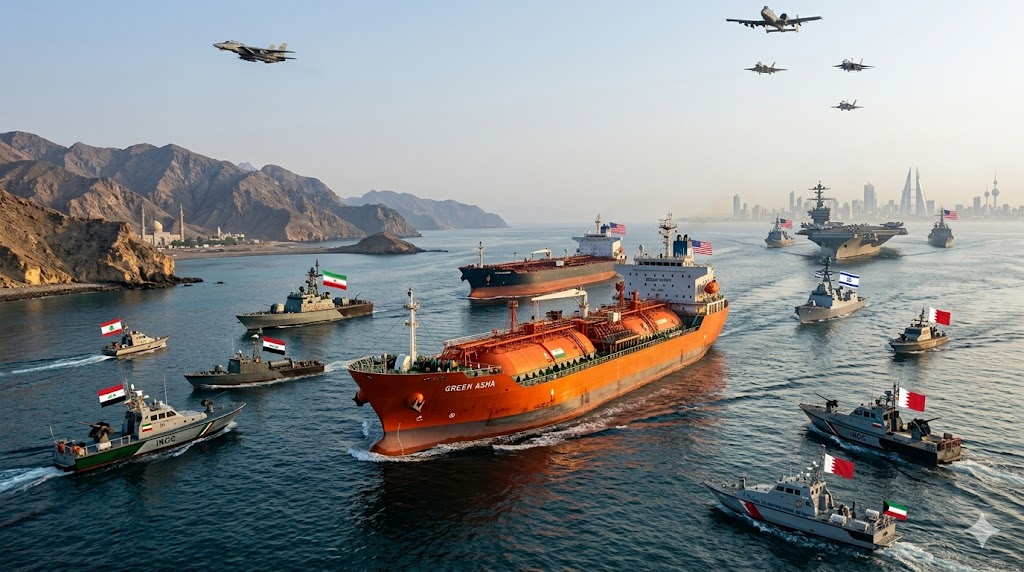
This image captures the intense fragmentation of the Strait of Hormuz in April 2026. On the left, the rocky coastlines of Iran shelter a coalition of Iranian, Iraqi, and Lebanese naval assets, overseeing the "safe passage" of strategic tankers like the Green Asha.
To the right, the horizon shifts toward the modern skylines of Bahrain and Kuwait, where a massive US Carrier Strike Group operates alongside Israeli and Gulf partner vessels. The scene illustrates a waterway split by ideology and alliance: one side enforcing a selective blockade, the other asserting a global presence, with the world's energy security hanging in the delicate balance between them.
Iran’s Calculated Openings: Safe Passage for India, Iraq, and Allies
In a pragmatic move, Iran has granted exemptions to select partners. India has benefited significantly due to its neutral stance and longstanding ties with Tehran. As of April 5, the ninth India-flagged LPG tanker—Green Asha—has safely crossed the Strait of Hormuz, joining earlier vessels like Green Sanvi (the seventh), Pine Gas, Jag Vasant, BW Tyr, and BW Elm. These ships carried vital LPG cargoes totaling tens of thousands of metric tons, ensuring India’s domestic cooking gas supplies remain stable despite the crisis.
Iran has publicly called India a “cherished partner,” allowing direct diplomatic coordination for safe passage. Similar exemptions apply to Iraq (exempted explicitly), China, Pakistan, South Africa, and the Philippines. This selective policy lets Iran maintain pressure on adversaries while preserving revenue streams and goodwill with key Asian buyers. For India, these successful transits—primarily LPG tankers—highlight effective diplomacy amid regional turmoil, protecting energy imports critical for millions of households and industries.
The Catastrophic Risks: What If the Strait of Hormuz Is Fully Destroyed
?
The Strait of Hormuz’s destruction or indefinite closure would represent a nightmare scenario for global energy and security. Oil and LNG flows would halt, spiking prices to unprecedented levels and triggering shortages across Asia and beyond. Refineries dependent on Gulf crude would face shutdowns, disrupting gasoline, diesel, and petrochemical production worldwide.
Electricity generation would suffer in nations relying on imported LNG or oil-fired plants. Undersea cables and communication infrastructure near the strait could face collateral risks from intensified military activity. Shipping lanes would become war zones, endangering seafarers and forcing naval escorts that strain security forces globally.
In the context of the US-Israel-Iran war, the strait serves as Iran’s ultimate “impact power place.” Full closure could strangle economies supporting the conflict, compelling concessions. Yet the human and economic cost would be immense: stranded vessels, environmental disasters from potential spills, and heightened tensions that could draw in more powers. Military analysts note decades of planning for such contingencies, but no easy solution exists without risking wider escalation.
Diplomatic and Military Dimensions Today
As deadlines loom—Trump referenced April 6 in earlier statements—international efforts intensify. Britain has convened coalitions to explore diplomatic, economic, and coordinated measures to restore navigation. Oman has engaged Iran directly on easing passage. Yet Tehran insists it will not yield unless attacks cease, signaling the strait’s role in postwar leverage.
For Middle East-Asia relations, the crisis reinforces the need for diversified energy routes, such as pipelines bypassing the strait or increased reliance on non-Gulf suppliers. India’s experience demonstrates how quiet diplomacy can secure vital interests even in conflict zones.
Conclusion: A Waterway That Shapes Our Future
The Strait of Hormuz has defined history through trade and tension, and its 2026 crisis reminds us of its enduring power. From ancient ports to modern tankers carrying LPG for Indian homes, the strait links the Middle East’s energy riches to Asia’s growth engines and the world’s stability. As Trump presses Iran with threats and Indian vessels continue their essential passages, the stakes could not be higher.
Reopening the Strait of Hormuz peacefully is not just a regional imperative—it is a global necessity. Until then, the world must navigate the delicate balance of diplomacy, deterrence, and energy resilience. The coming days will test whether reason prevails over escalation in this vital artery of the global economy.
Frequently Asked Questions
What is the primary significance of "Strait of Hormuz: Global Lifeline in 2026 Crisis"?
The Strait of Hormuz stands as one of the most vital waterways on the planet, a narrow chokepoint that connects the Persian Gulf to the Gulf of Oman and, ultimately, the Arabian Sea. For centuries, this strategic passage has shaped global trade, energy flows, and geopolitical rivalries.
How does this development impact International Affairs?
Today, in April 2026, the Strait of Hormuz finds itself at the heart of a dangerous escalation in the ongoing US-Israel war with Iran. With Iran selectively blocking most traffic while allowing safe passage for friendly nations like India and Iraq, and US President Donald Trump issuing fresh ultimatums threatening “all hell” if the waterway does not reopen, the world watches anxiously.This article explores the history of the Strait of Hormuz, its unmatched importance to the Middle East, Asia, and the global economy, and the profound risks if the strait were to be fully closed or destroyed.
What are the key future projections to monitor?
It also examines the current crisis, including Iran’s calculated openings for Indian LPG tankers—the ninth of which crossed safely in recent days—and the broader implications for energy security, shipping, and international stability.A Brief History of the Strait of HormuzThe Strait of Hormuz has long been a crossroads of empires and commerce.